
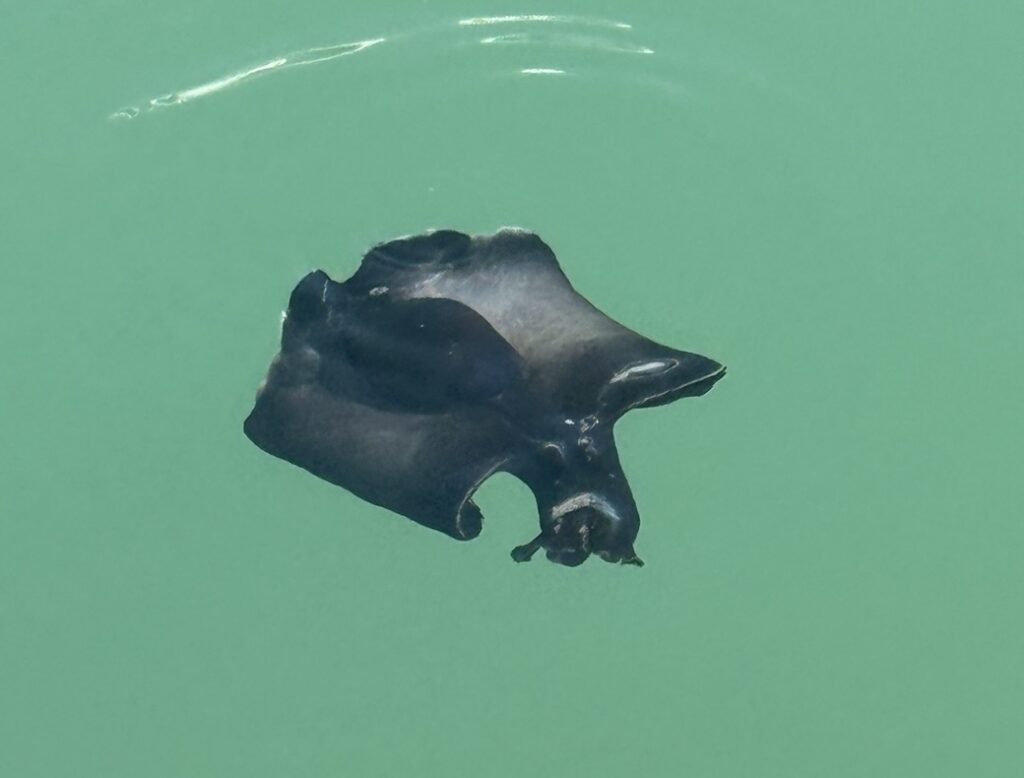
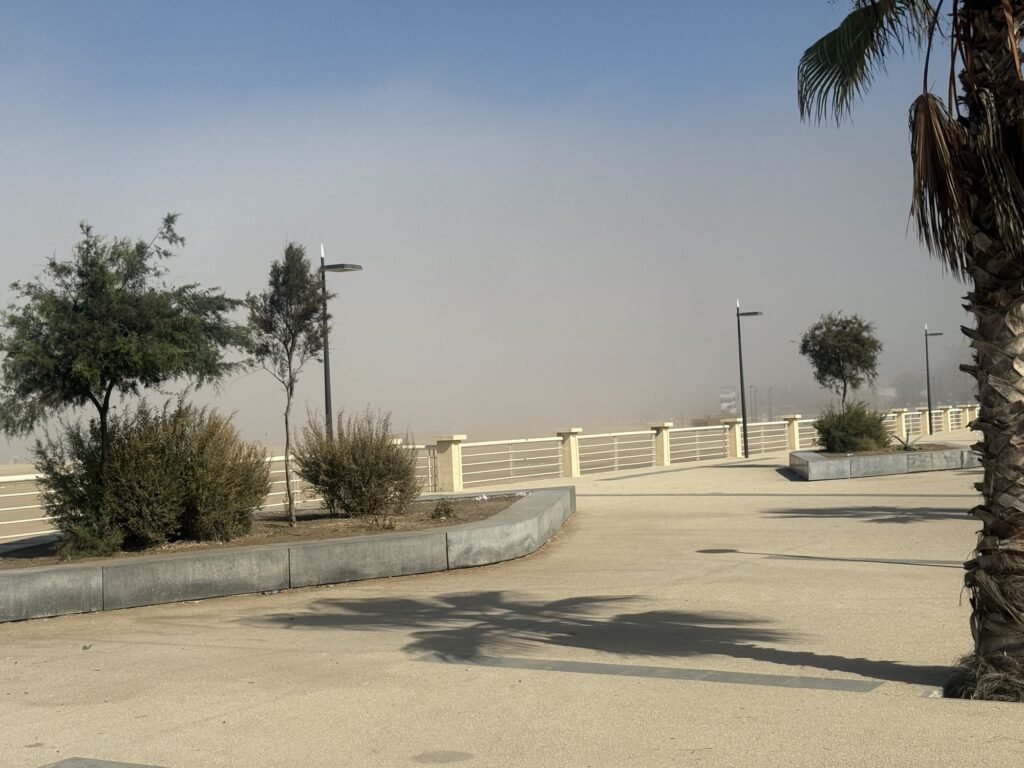
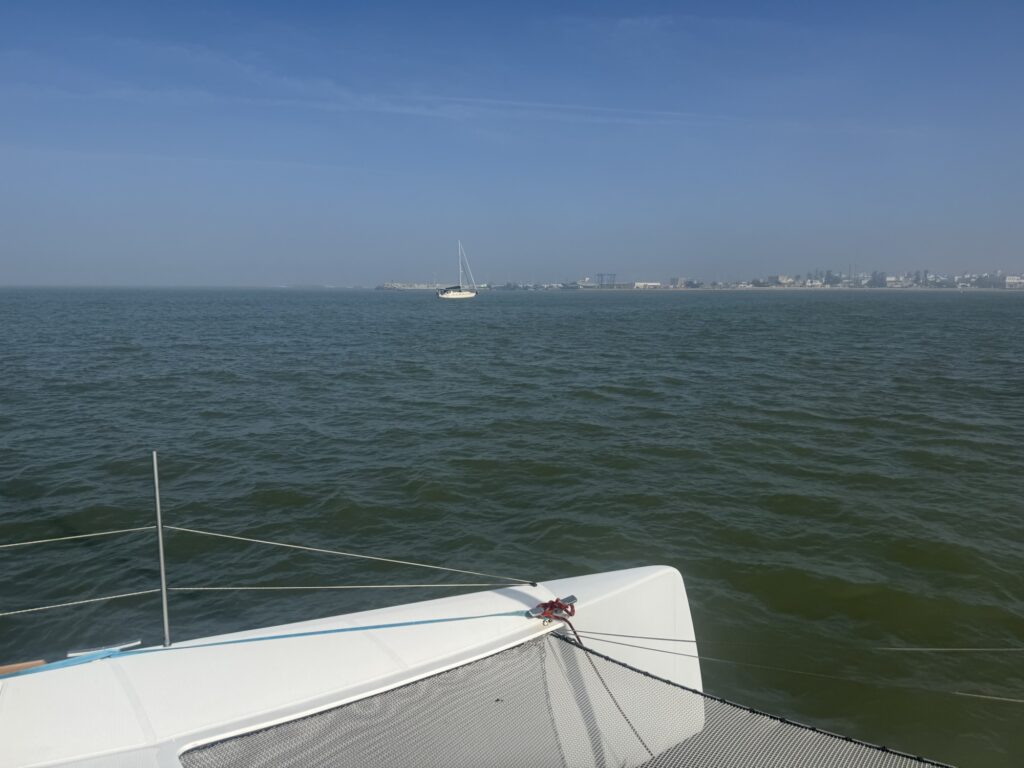
It's 07.30 and we're anchored in Essaouira. At least that's what I think, I can't see any of it. It's so foggy that we can't even see where our anchor chain goes into the water. There is absolutely no sign of other boats that must be moored here or even the harbour, the shore or the town. It is so wet that the deck is not covered in the usual dewdrops that make everything damp, but there is a thick puddle in the cockpit. The trousers, which I had hung up to dry and left hanging to dry completely in the morning sun, are sticking to the line like the famous wet sack. It's also rocking. The wave comes from the side and as our trimaran has a slight V-shape, it rocks until it is abruptly stopped by the opposite hull, then it goes back. Not a soft rocking motion, but a slightly choppy back and forth. It ripples nicely, but this is accompanied by the howling wind. We have a wind of around 20 knots (wind force 5), but it's not able to blow the fog away. So I sit inside and heat up a bit with the gas cooker, which has made me some delicious coffee. Katja is still asleep, having not slept much or well during the night. And to explain the title: as we didn't want to be online all the time, the little Elon Musk dish is installed outside and connected to a mobile cable. You have to plug it into the socket inside and open the door or window. And I don't do that. I'm not going to swap my painstakingly created warmth for some Wi-Fi, which then flows into the lounge with cold, damp air.
Yes, you read the mood right, things are not going so well at the moment. After spending 3 days in Tangier and hoping to find some female sailors, the two of us set off in the direction of Rabat / Agadir. Rabat had cancelled us several times because the marina was full, but at least they had replied and maybe someone would set off unexpectedly. The wind was supposed to be favourable and we got off to a relatively good start. We had arranged with customs that we would leave at 06.00 and check out. We then decided not to leave quite so early in order to get a good night's sleep. We arrived at the customs jetty at 7.30am and our colleagues from customs arrived at 9.30am. We were finally able to cast off at 10am, just at the time when I had a video conference with my German customer. I was late for the conference, which I attended while Katja steered us out of the harbour and the bay. The wind was light from the front but the current was with us. It was a pleasant feeling to sail the 8nm that we still had to cross from the Strait of Gibraltar with the support of the current. After two hours, we turned left to sail south along the Moroccan coast. In the meantime, we had set sail and made good progress in light to moderate winds. We had decided to keep well away from the coast to avoid poorly lit fishing boats and possibly even fishing nets. We were travelling at 8-9 knots at times and were already thinking of sailing through to Agadir in one go. The first challenge was the first night: due to our great distance from land, we were sailing in the middle of the busy shipping route for ships heading either to Africa or the Canary Islands, or for those heading to Asia, saving the Suez Canal and sailing around Africa. They also avoid the Cape of Africa, which poses quite a risk of piracy off Somalia. So we travelled along the coast in these boats, some of which were 300 metres long. We took turns every 2 hours, whereby we both endeavoured to let the other sleep a little longer if we were still able to. At two o'clock in the morning, I couldn't do it anymore. The hint of a cold, which I thought I had overcome in Tangier, returned, fuelled by lack of sleep, cold and wind. Fever and chills had me knocking tentatively on Katja's bunk prematurely, I just couldn't take any more. It was a pretty frustrating feeling. After all, I was the experienced sailor and responsible for safety and the crossings. In my mind, I wanted to let Katja sleep and, as an iron sailor, sail through the night alone if in doubt. Now I was a trembling sailor and needed Katja's help! And she came. Katja took over and spent hours at the helm with great stamina. When manoeuvres were due, I mustered my remaining strength and we mastered reefing, tacking and jibing together. Or when one of those who worried Katja the most came too close: Together, we dodged a moving 320-metre-long pile of containers at a fairly close distance, where it was no longer even possible to guess where the bridge might be. There's probably a container right in front of their window, which means they can't see us. While I tried to sleep in my bunk and regain my strength, I was able to make a decision, fuelled by my fever: Abort! We'll make it through the night, but we can't go on like this. I had a plan B for this scenario and that was: Mohammedia. This town lies between Rabat and Casablanca and has a fishing and industrial harbour and a "yacht club", but more on that later. However, the decision also meant that we wanted to turn right at the moment of our greatest distance from the coast. That meant 50nm across the direction of shipping but still with the wave in the direction of land, i.e. a journey of around 8 hours to the safe harbour. The decision was of course ambivalent. We were making good time, were on an optimal course far away from fishing nets and were now supposed to make a long diversions. In the end, it was clear that safety first and continuing with our small crew would have been just too risky. And that's why we had plan B!
Mohammedia gave us a friendly welcome over the radio, they had room for us. We drove a huge arc around all the dangerous buoys past an industrial harbour, towards the stench of fish. With my usually blocked nose, I suffer from strong odours to a limited extent, but Katja is equipped with an extremely fine sense of smell. She will certainly write about the smells of Mohammedia herself, so I don't want to give too much away. We were directed to the farthest corner of the marina, where I once again had the chance to practise harbour manoeuvres with a trimaran. Not easy, as it was very narrow, but at least there was no wind. We were given a very warm welcome and the police and customs were also very friendly and relatively quick at the start. And on the boat: In Morocco, nothing works without an inspection of the boat and so 2 men and a woman trudged through our boat, which had been shaken by the night journey. The inspection seems to be quite random: sometimes they look in the drawer, sometimes in my rucksack, then they energetically pull a crate from the shelf and lift the bottles inside. I would have liked to know what they were actually looking for, but I didn't dare ask. After all, they came on board without a dog, which happens quite often. Incidentally, we were pretty much the only yacht in the Mohammedia Yacht Club. Our neighbours were all small fishing boats, right next to us was Omar, who offered fishing trips with guests and shared the whole thing on Omar's Pesce Vlog on YouTube. Omar was very nice, as was everyone in Mohammedia. So our unplanned stopover also had something good about it. We stayed 3 nights, which were the most expensive nights of our trip so far. Somehow the yacht club had decided that if they were going to offer sailing tourists a place to stay, they had to ask us to pay for it. Although we are as wide as two normal sailing boats, we only paid 1.5 times the normal rate, i.e. €75 per night. In return, we had water, electricity and a shower - everything we needed. And the support of Hisham, who helped us to fill gaps in our equipment, such as lead weights for diving. And also gaps that I didn't even know about: I now have a variety of lures, leaders and hooks to become a great angler after all.
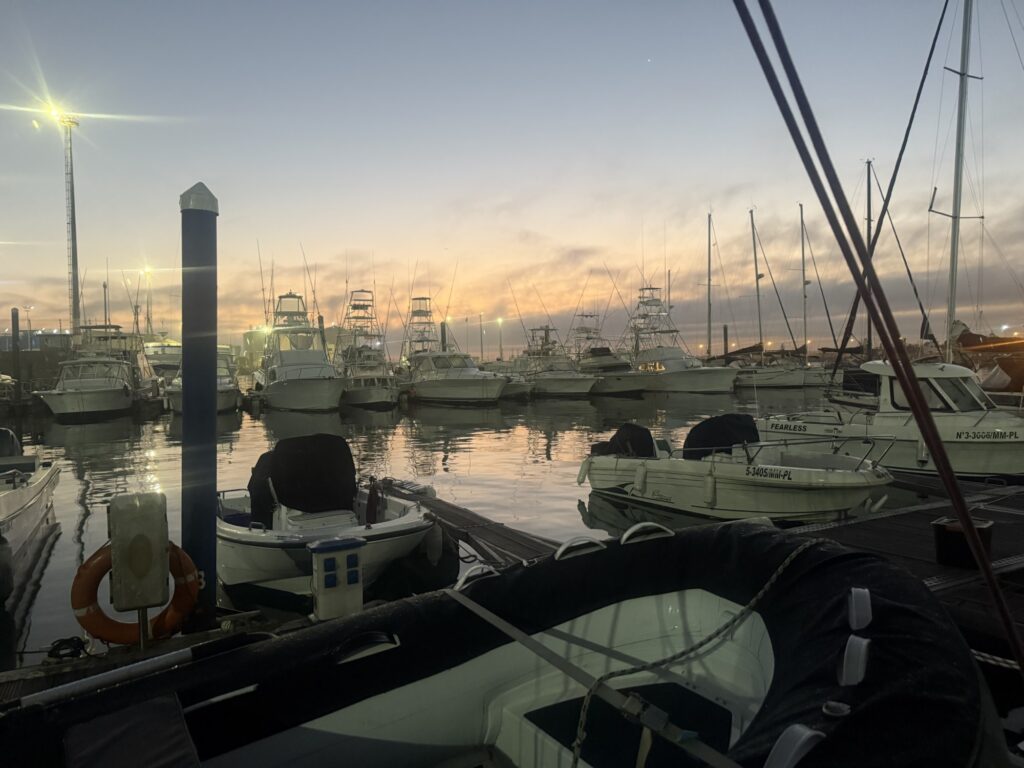
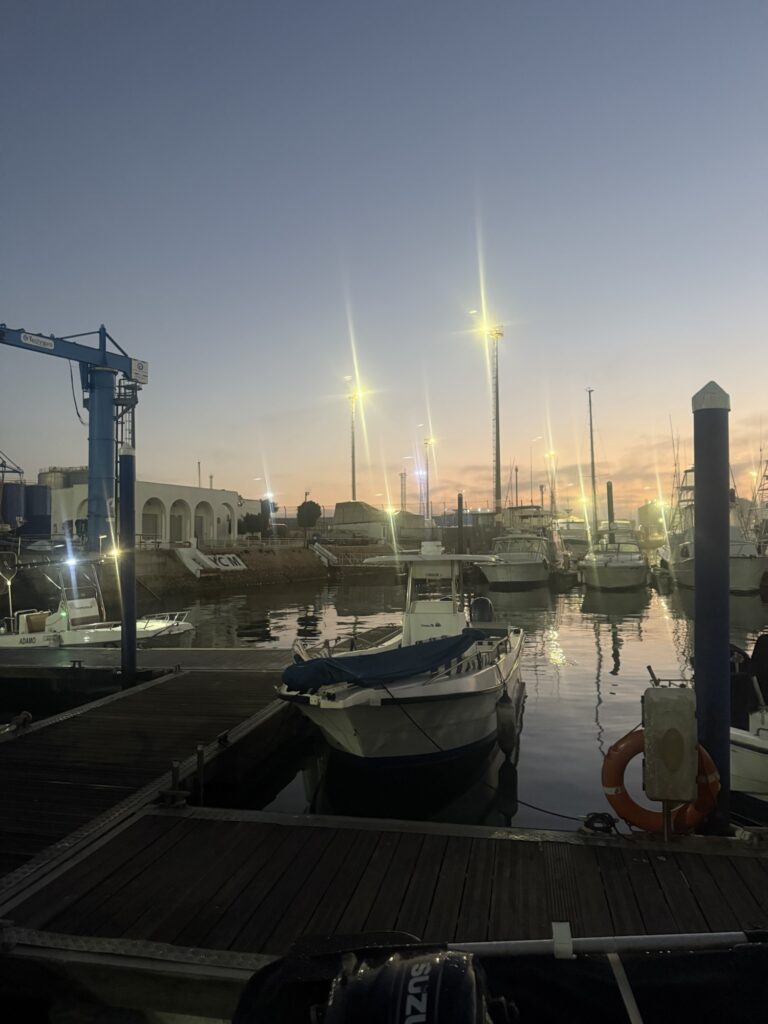
We tried to recruit Omar to sail with us to Essaouira or Agadir, teach us how to fish and make a YouTube film about the Biosphera. He thought it was a great idea, but he can't sail and has a wife and two children in addition to his paying charter guests. We also have children and we tried to persuade them to fly to Casablanca and sail on with us. After the last night, we thought it made sense to have more crew. It almost worked, one flight was already booked but was then cancelled. It was all a bit last minute and not that easy. But it gave us an intensive day with family issues, which are of course always on board alongside our practical challenges.
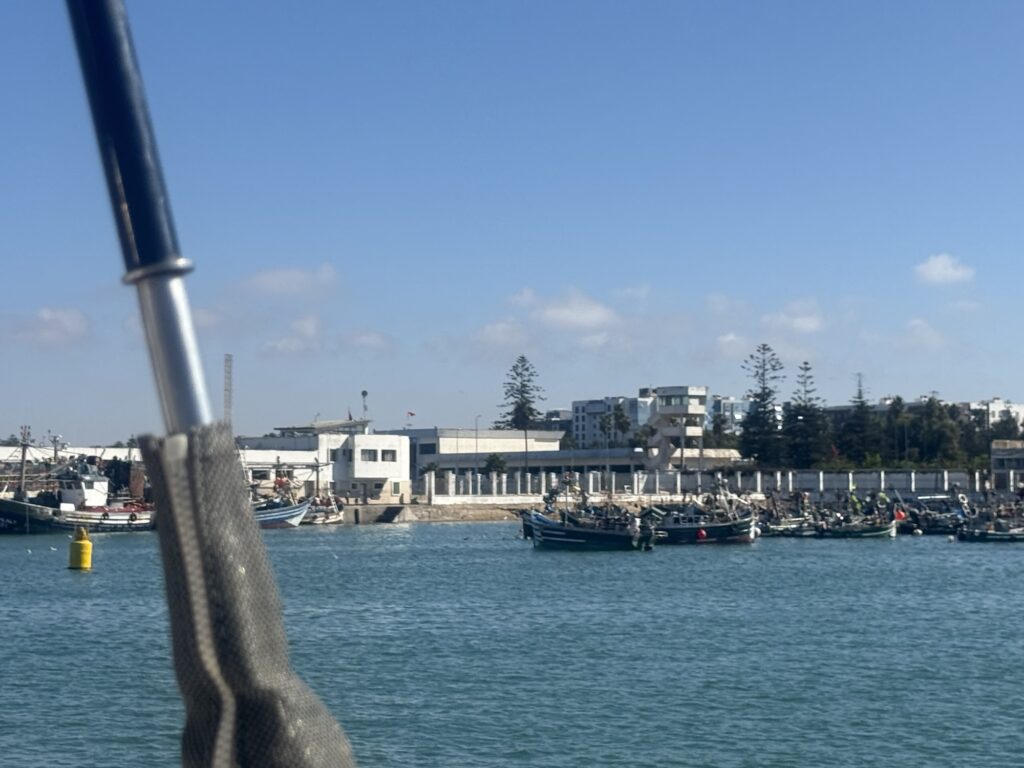
We were supposed to continue on Sunday. By now we really couldn't smell Mohammedia any more and the wind should still be good. I was fit again and the idea of waiting any longer and then having weak winds with big waves from the side immediately brought the sound of flapping sails to mind. There is nothing more unpleasant than slow sailing and sails flapping back and forth through the waves. So we set off from Mohammedir, again with the tried and tested small crew. Our destination is Essaouira and, at the very most, in the back of our minds, Agadir, which is another 85nm further (nm stands for nautical miles and one of these is equivalent to 1.85km). This time we take it easy and no longer expect the police and customs to arrive at 9.00am as arranged. At 10am we pay our bill and prepare our Code D, at 10.30am the police come on board and at 11am we are on our way again. Mohammedir had some nice moments, but we are looking forward to travelling on. After 2 hours under engine to get out of the wind hole off the coast, we set the code D, our orange light wind sail. It's great and with half the wind we quickly make 9-10 knots of speed. Wow, that's fun! The boat rushes through the sea, one of the three hulls floats above the water and we make great progress. It goes on like this for a while, we eat, turn on the music and enjoy the boat, the wind and our great journey. Until it makes a rather loud "pung" and the Code D crashes to the ground, or rather into the water. The halyard had rubbed through the mast fitting and was torn (you pull up the sail with a halyard). I know this from previous trips, but after only 3-4 hours of sailing, it's really early. Up to this point, Katja and I had taken good care of ourselves and conserved our energy - a lesson learnt from the last night trip. Now we were both in action and pulled the 110m² canvas out of the water at a residual speed of 3-4 knots. We actually managed it quite well, the sail was back in its bag after about 45 minutes and after a good hour we were sailing again with standard sails, i.e. with genoa and mainsail. However, this was still in the 1st reef, as we hoped that the Code D would stand up better in aft winds (wind from behind) and not be shaded so much by the mainsail. That was no longer the case, as we now sailed the part of the crossing where we had the wind from behind without Code D. And that was exactly what it was intended for. So now we had to try to sail as low as possible with the mainsail and genoa. It may come as a surprise to non-sailors, but the truth is that you can't sail directly into the wind, but directly downwind is also stupid. There are courses such as "butterfly", where the mainsail is on one side and the headsail on the other, but this is a very unpopular course, at least if you haven't prepared well for it. So we tried to sail as low as we could without the sails flapping and collapsing. That's about 150° to the true wind or 135° to the apparent wind, depending on the speed. The overall speed is then no longer as high, the boat travels much faster with half the wind (wind from the side) than with wind from behind. So Agadir is off the table, or rather with the code D in the water, we set course for Essaouira. At the same time, I try to contact the marinas via other sailors to find out where we can go. The marinas themselves don't usually reply. We decide on a new wake-up rhythm for the night: to allow a 90-minute sleep cycle and 15 minutes each time to get dressed and undressed, we want to wake each other up after 2 hours.
The next morning it became clear that we were travelling a much longer distance due to the restrictions of the course and were not as fast as we had hoped. The wind remained light and we had only made 4 knots in the night. Even though it was supposed to get better from midday, Essaouira was still a long way off. At least the wave was with us and when we surfed a wave, we were once again travelling at 9 knots. However, it then goes up again out of the wave trough and the speed then drops to 5 knots. It wasn't until late afternoon that we dared to go butterfly, which meant we were travelling at 8-10 knots again in 20-25 knots of true wind. Every sailor can imagine that downwind sailing in 2-2.5m waves and 5-6 knots of wind is a real challenge despite the "bull stander". (A bullstander is a safety line that additionally secures the main boom to prevent the boom from slapping from one side to the other when you steer or the wind shifts). The autopilot and I took it in turns to steer with high concentration, although I don't know who did it better. At least the autopilot didn't say "shit" out loud when the genoa folded in again and inflated again with a loud bang. We were now finally approaching Essaouira, a well-known strong wind area, at high speed. It was hazy and cloudy, so it was foreseeable that we would not be able to count on a long twilight after sunset. Visibility was already not so good and we had a choice: hoist the sails in a force 6 wind and 2.5 metre waves on the open sea, but with sunlight, or sail into the bay of Essaouira and then hoist the sails in calm water, probably in the dark. We decided in favour of the recovery at sea, which turned out to be a good choice. As we approached the entrance to the bay of E., the wind picked up to 30 knots and it was not only dark but also completely foggy. Bright lights on land could be recognised as hazy little dots, nothing else. We sailed into the bay practically blind and relying on the GPS plotter. We had made contact with the "Slow Motion", a German ship that we had briefly met in Tangier and that was moored in the bay. They wanted to guide us with flashlights and deck lighting. We saw absolutely nothing. The waves dropped in the bay, but the wind remained at 20-25 knots, as 5-6 Bft (wind force). Fortunately, the bay is huge and we sailed a wide arc with the help of GPS until we saw small dots. These were the anchor lights of Slow Motion and other boats, but they were already quite close by the time we saw them. We didn't try to approach the optimum anchorage indicated by Slow Motion through the other boats, but dropped our anchor behind the others and gave 55 metres of chain. There was plenty of room and once again I loved our anchor (Sarca Excel 30kg), which we can drop blind and I just know it will hold. First time, bombproof!
Then it was quiet for a while. We rocked slightly, set an anchor alarm and tucked into the spaghetti left over from lunch. I was so relieved that I got the guitar out and we sang together, which encouraged Katja to round off the cosiness by making bread dough.
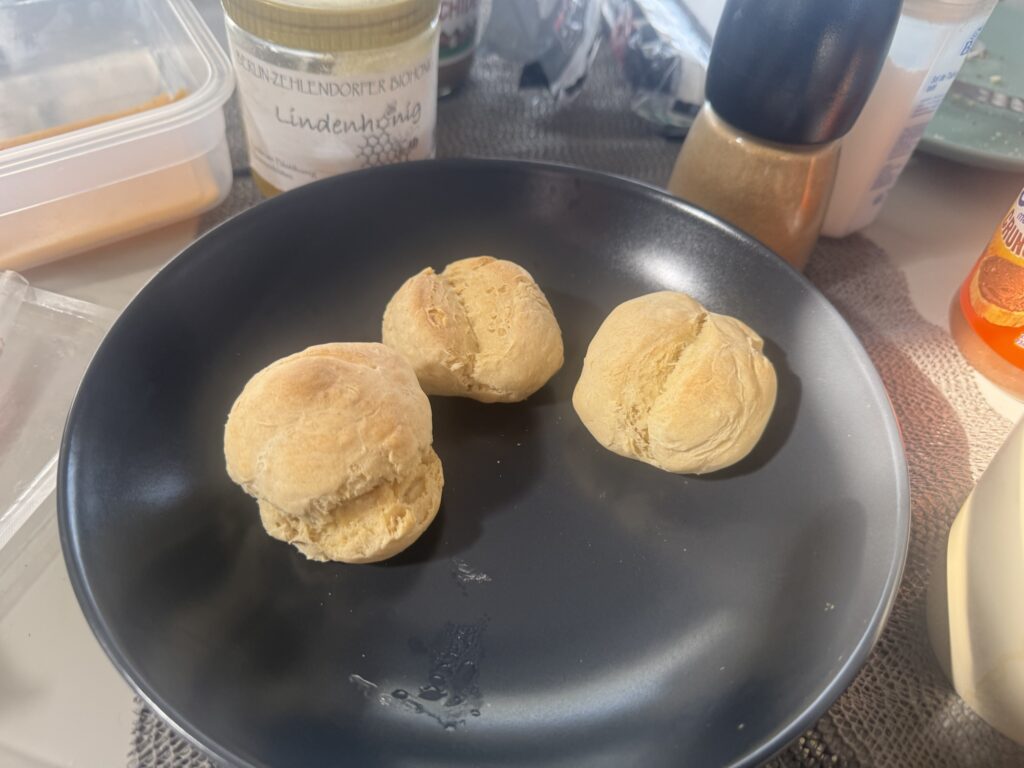
In the meantime, Katja is also awake and turns the dough into fresh bread rolls. The oven and the gas cooker boiling coffee make the clammy lounge increasingly cosy and rays of sunshine make their way through the fog. The first outlines of our neighbours become visible - it's sure to be another great day in Biosphera's paradise!
Dear Martin
We were just lying warm and cosy in bed in our holiday flat in Naxos - the storm was howling outside - but we were safe while I read your captivating report out loud, almost breathlessly, so that Tojo could also take part.
We are both non-sailors, I am at most a co-sailor, but it is beyond both of our imagination to do what you are doing. 🙏
Chapeau !!!!
I was in tears at the end of your report....♥️
You have written this sooo beautifully.
( I also found it very pleasant that you explained technical terms to non-sailors )
God bless you ❣️
All the best and stay healthy, Martina and Tojo 💞
Man, your journey is incredibly exciting. Simply brilliant how resilient you are and somehow always manage it! Thanks to smart decisions too. I find it very reassuring that you minimise risk and put safety above all else. I would love to see you again! ❤️ Hugs from faraway Berlin 🙏
Give you a big hug too! Thank you for your support and for the really valuable contact with Morocco. You can look forward to seeing what we have experienced here!