
This post is a reflection from Cape Verde, which we travelled to between November 2025 and January 2026, before our Atlantic crossing. There will be more posts about Cape Verde and hopefully a podcast :).
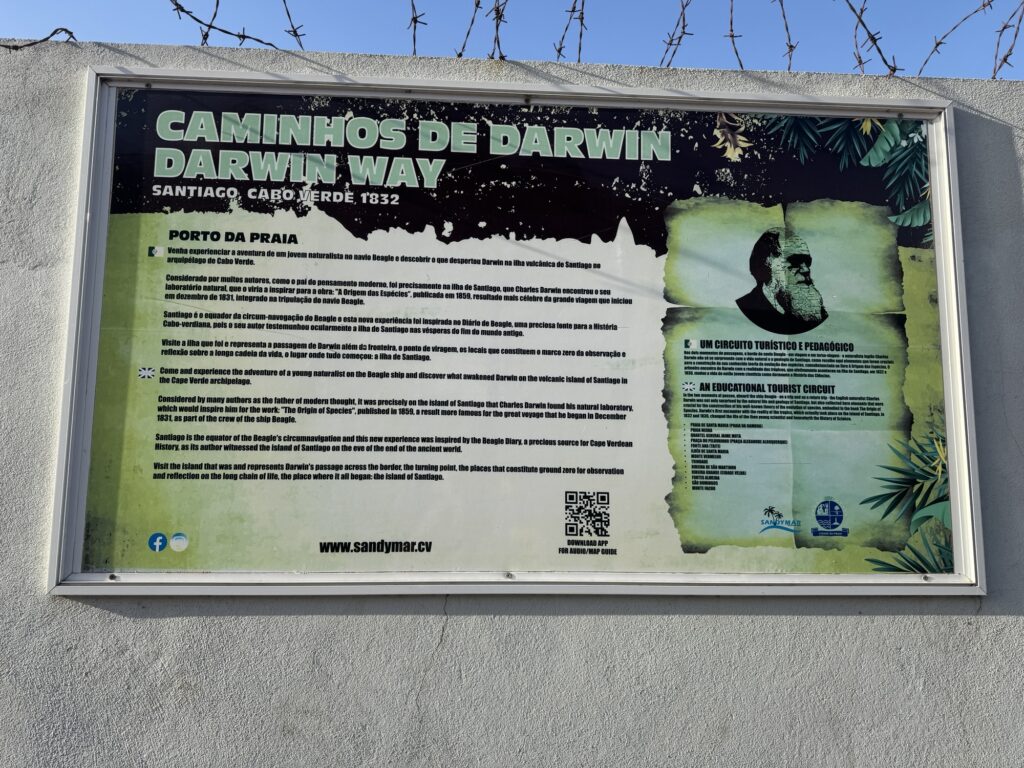
Darwin entered Santiago in 1831 as the first Western European naturalist (that we know of 😊). He was simply intoxicated by the tropical diversity. Santiago is the largest island in Cape Verde and is also home to the capital Praia. Darwin saw the tropics through the eyes of Humboldt, who had travelled through South America years earlier. Almost 200 years later, I am now reading the biography of Alexander von Humboldt (by Andrea Wulf) and am fascinated by how he described and, one could say, "discovered" the relationship between nature and man. I am also fascinated by the diversity and often try to comprehend Humboldt's thoughts. On 1 January 2026, I'm sitting on the deck of our biosphera and blurt out the sentence: "The beauty of nature is revealed through its inner constitution." Martin laughs and says that's very poetic on New Year's Day. I realise that the sooner I rest within myself, the more I see, smell, hear and taste. You certainly don't need to sail 3,000 miles to come to such a simple realisation, but it is much easier to recognise what I am actually carrying in my luggage or how open I really am to new things when I am abroad. How often do I find myself making comparisons, using the knowledge I have learnt as an interpretation pattern, pigeonholing circumstances or people. Martin and I often repeat the phrase on this journey: "We always take ourselves with us!". Instead of enjoying and celebrating the beautiful plants, people, geological forms or whatever in the here and now, we sometimes find ourselves grumbling about one thing or another or thinking the same (often even negative) thoughts over and over again. If you don't manage to be relaxed and happy at home, you won't be either in the most beautiful surroundings! Only in beautiful surroundings is this much more noticeable!
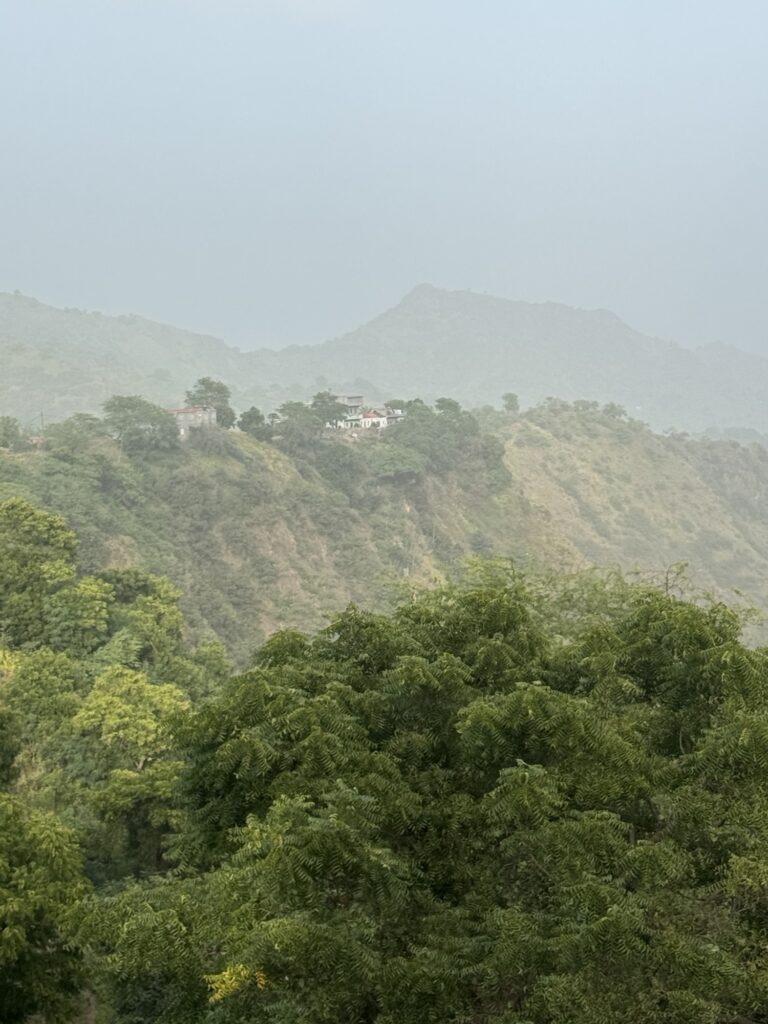
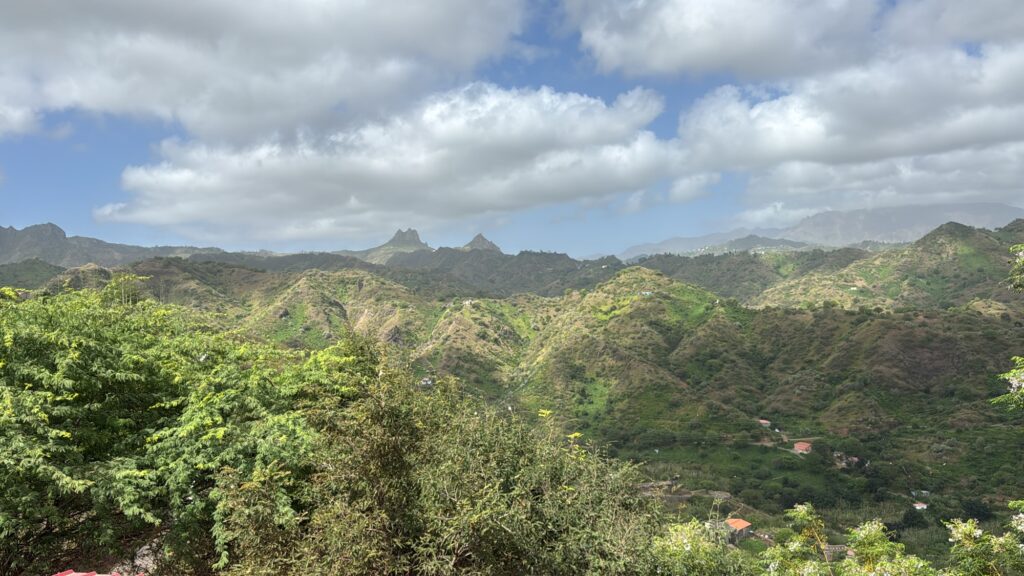
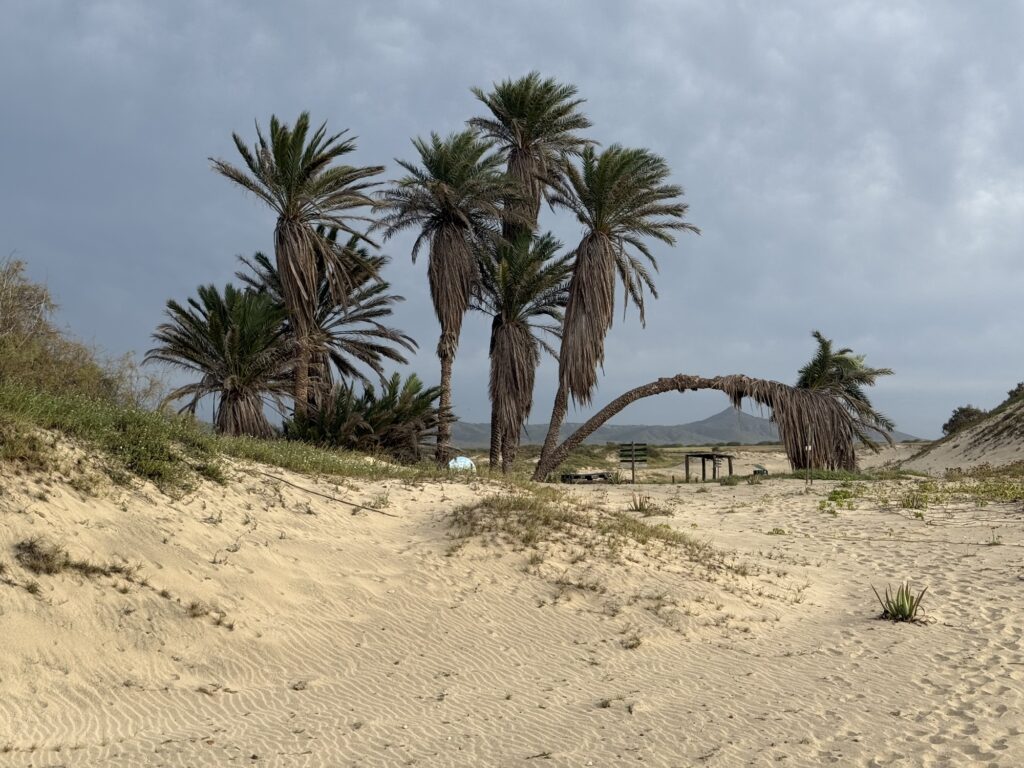
Nature pictures on my status, which could be typical catalogue pictures, are very popular with my friends: white endless empty beaches (like on Maio), rugged wild mountains (Sao Antao), forests - they are landscapes of longing. I also really enjoy these landscapes and there is so much variety on the Cape Verde Islands that you simply can't get enough of them.
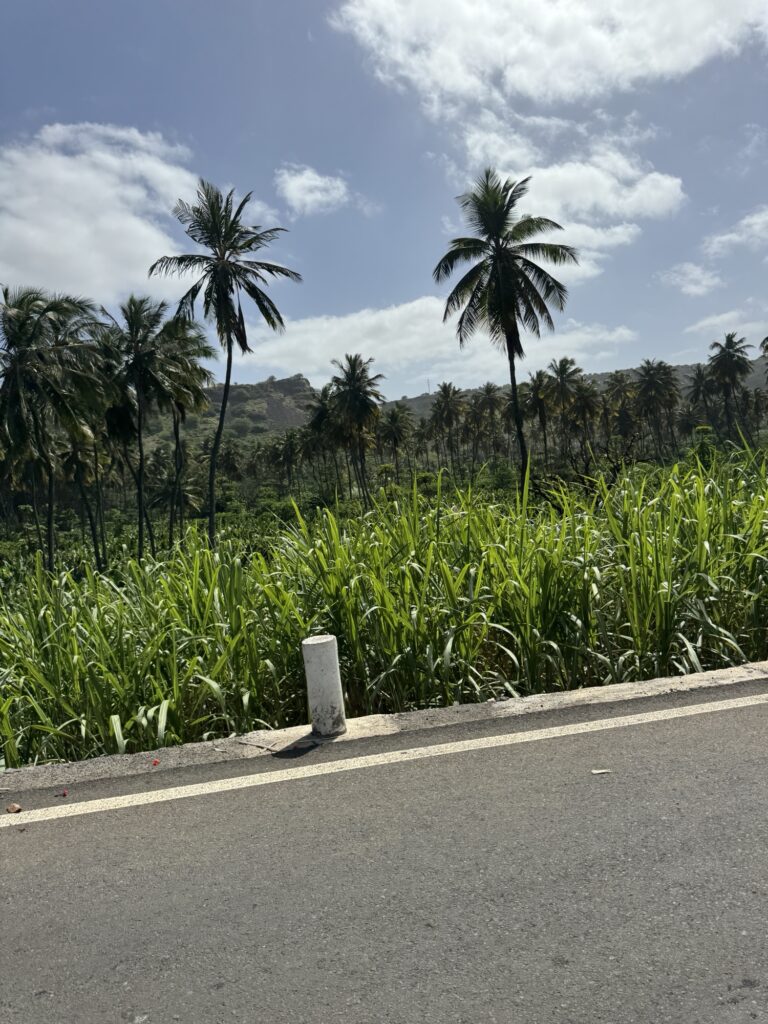
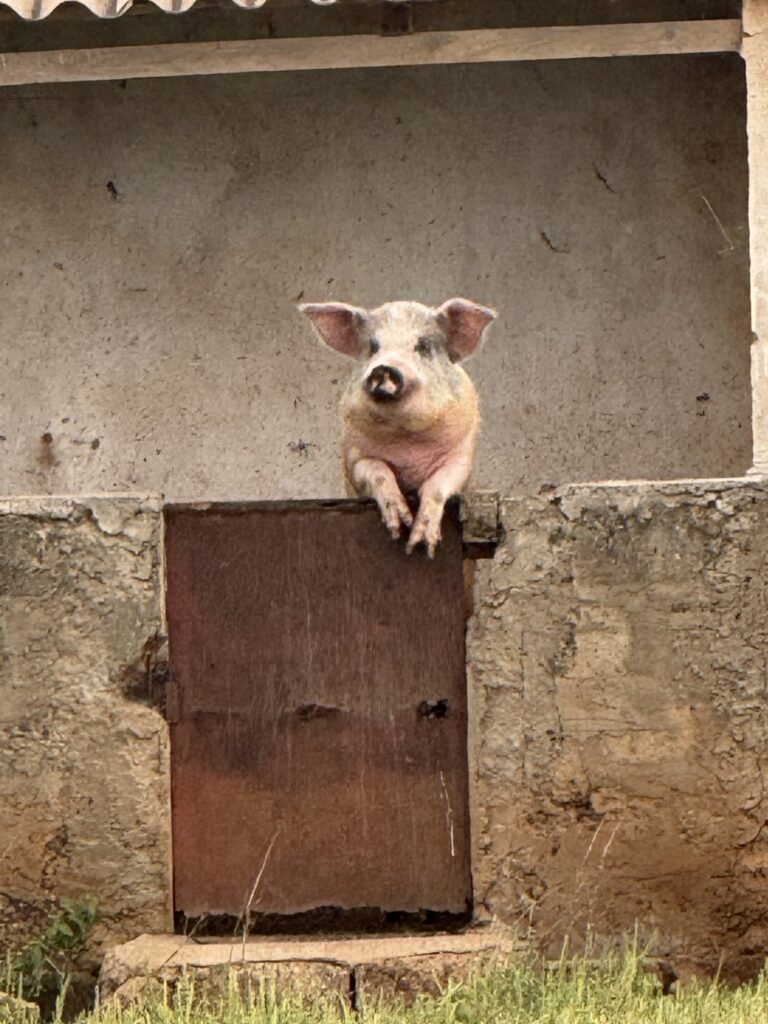
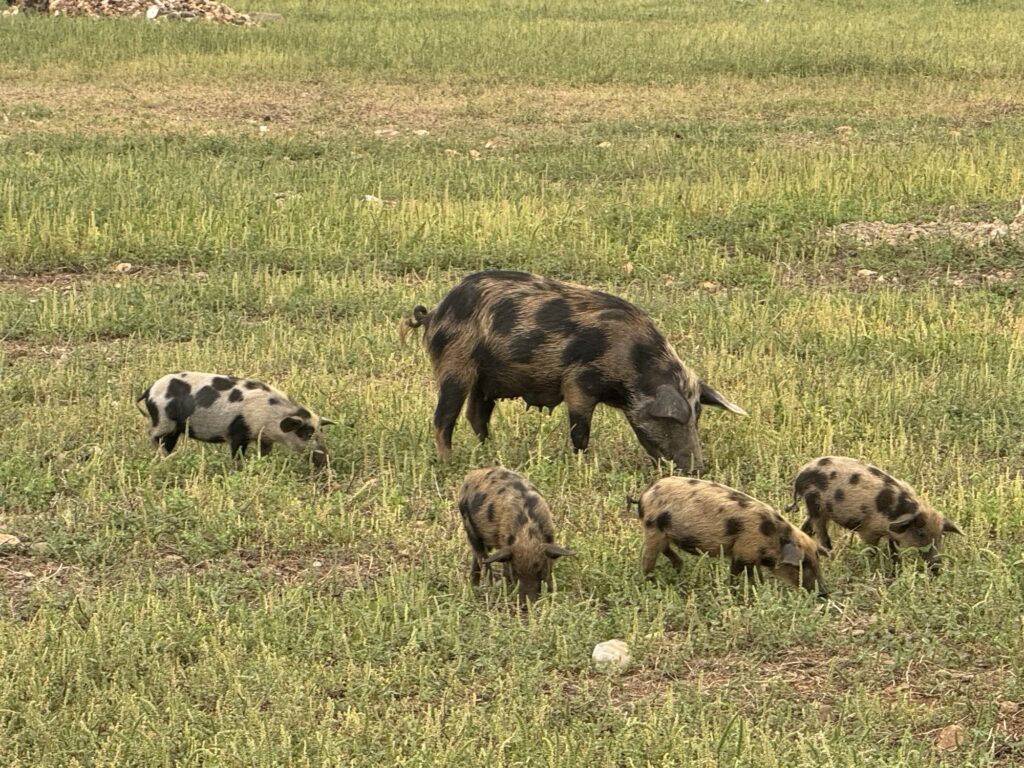
But what about the people from Cape Verde, can they appreciate their own nature? In the simple villages, they live very close to nature, with a few goats, pigs, free-range chickens, donkeys and the occasional cow. I didn't discover a large chicken farm anywhere, hardly any signs of industrial farming. There is certainly some mismanagement here too, but very little compared to what I saw elsewhere. The fields mainly produce maize, beans and pumpkins: also known as the three sisters, because the maize shoots up, then the bean gives it a chance to climb and finally the pumpkin with its many leaves is able to cover the ground and keep the moisture in the soil. An ideal combination and it seems that word has spread all over the world, as this combination is planted in North America and Kenya. The idea must have originated in South America, as maize, beans and pumpkins originally come from there. Sugar cane, bananas, coconut palms - all plants that originally come from the South Pacific - also grow in Cape Verde, wherever it is warm and humid. Back to my question: do the people of Cape Verde appreciate this nature? I say YES!
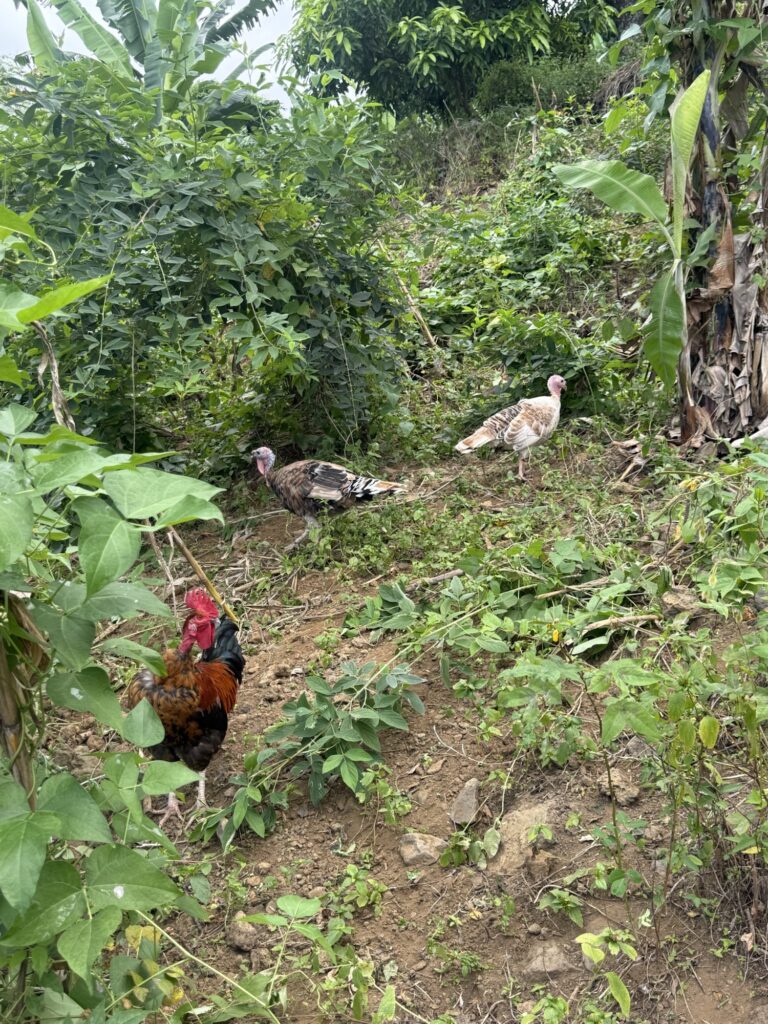
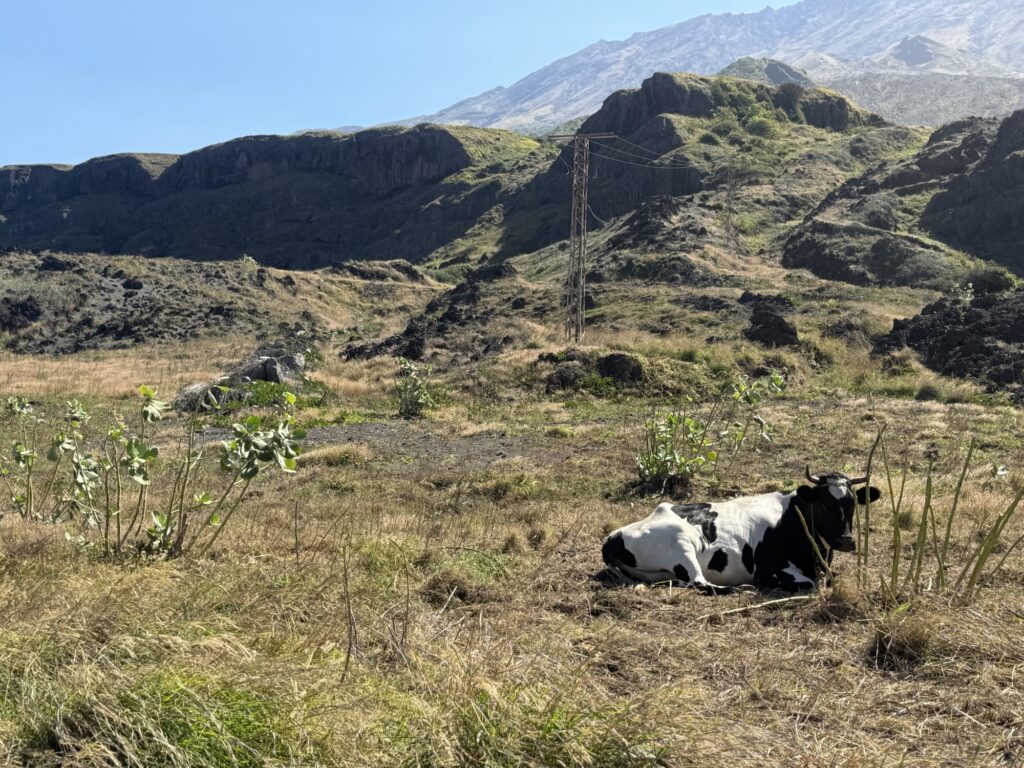
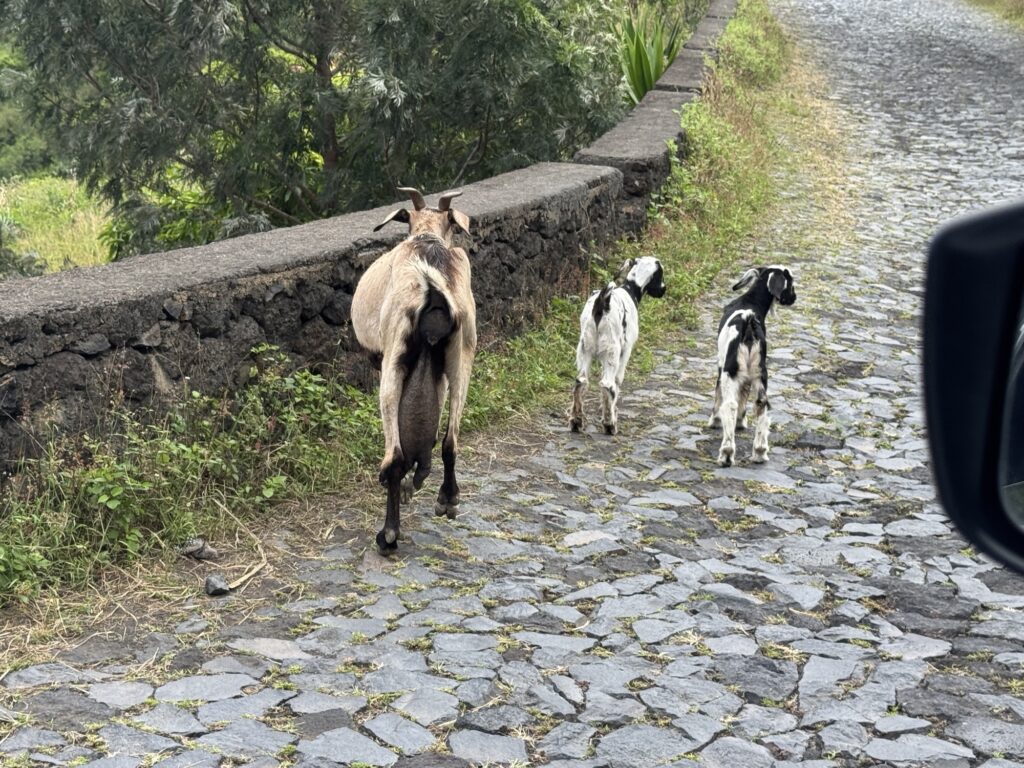
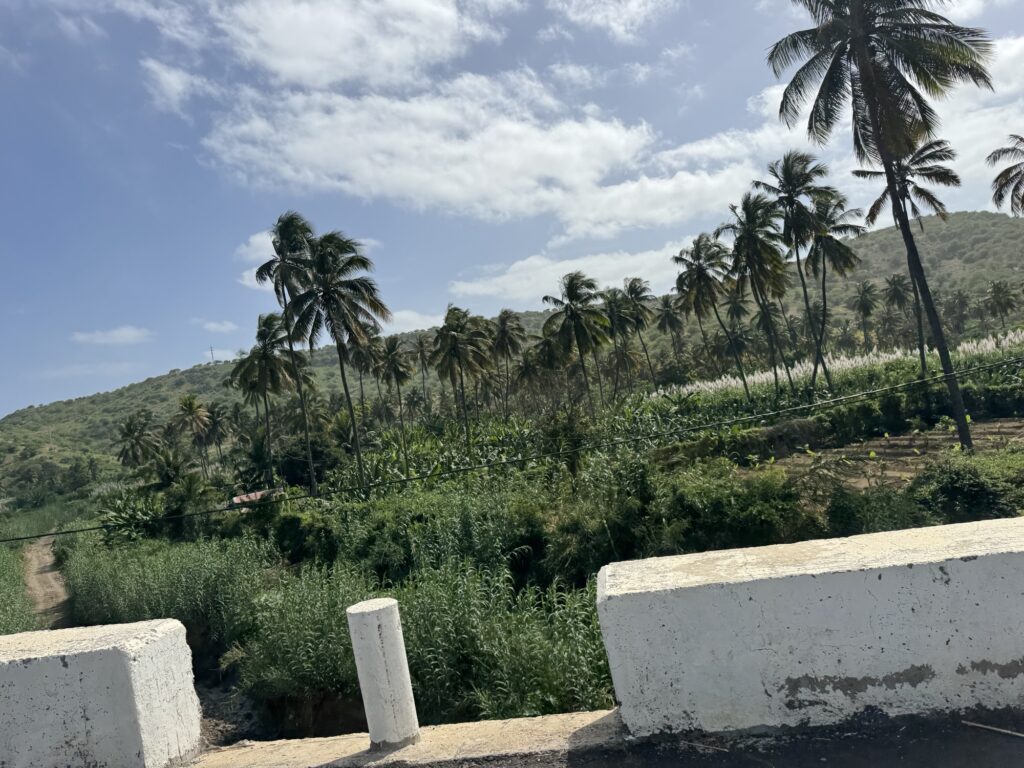
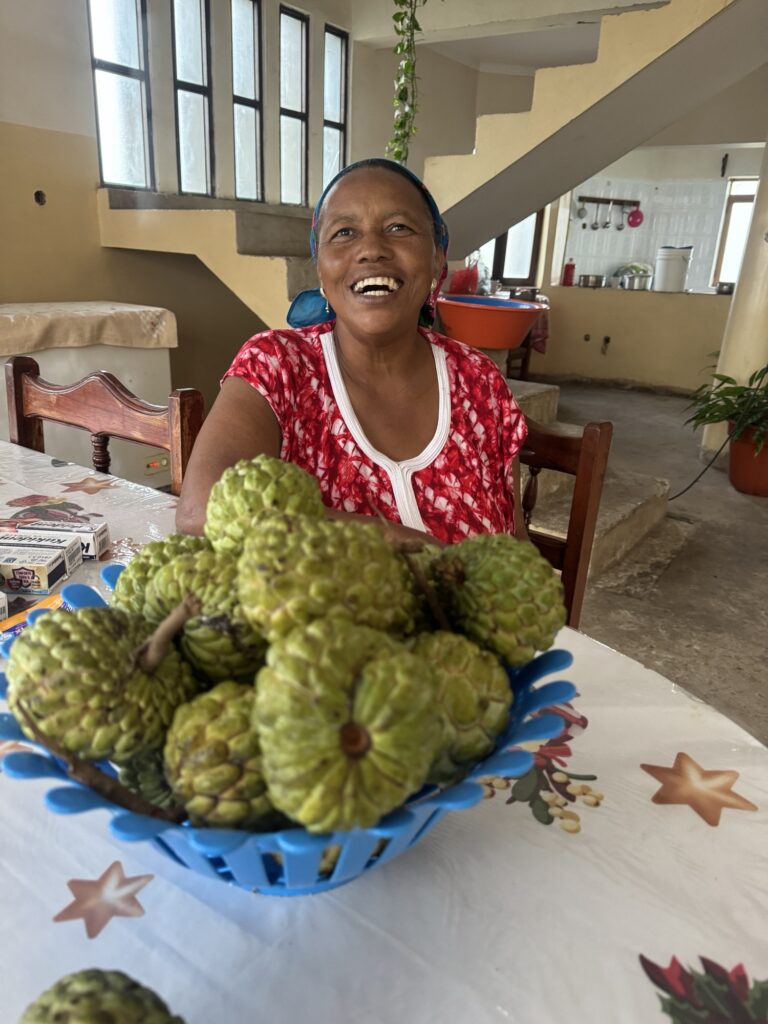
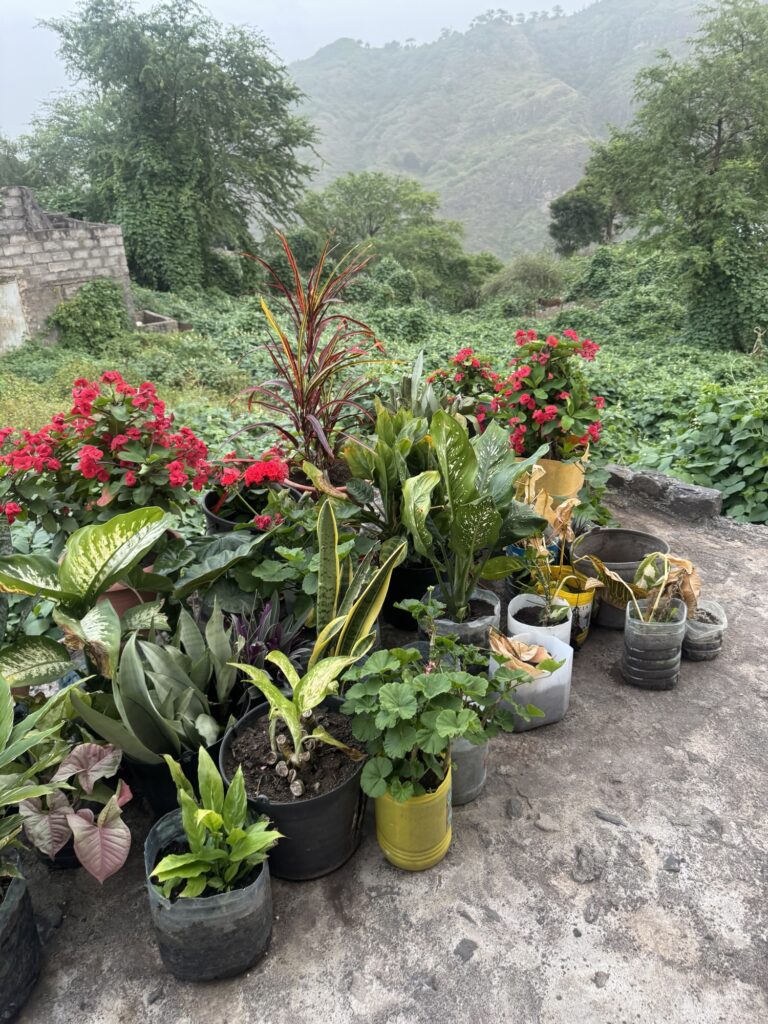
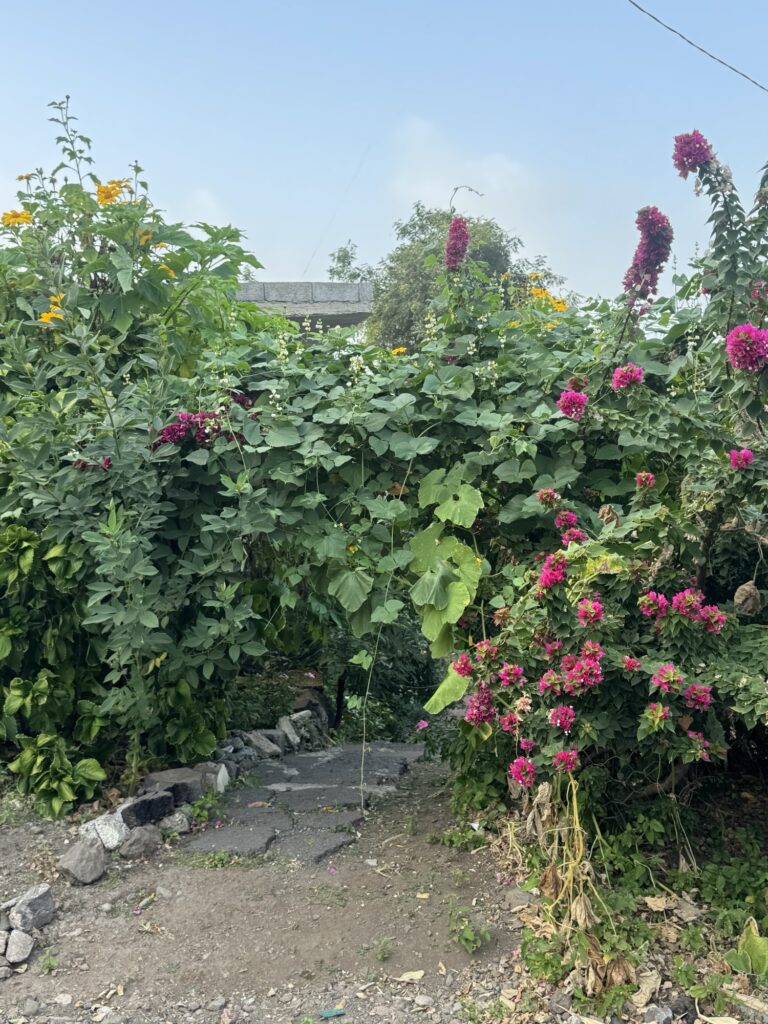
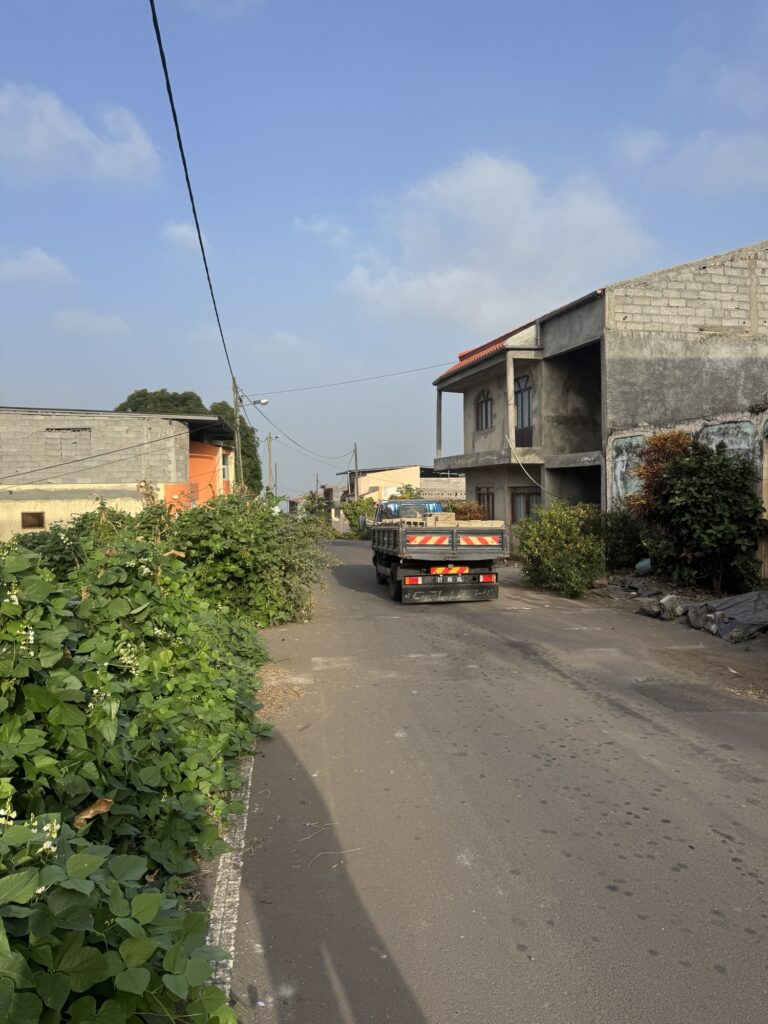
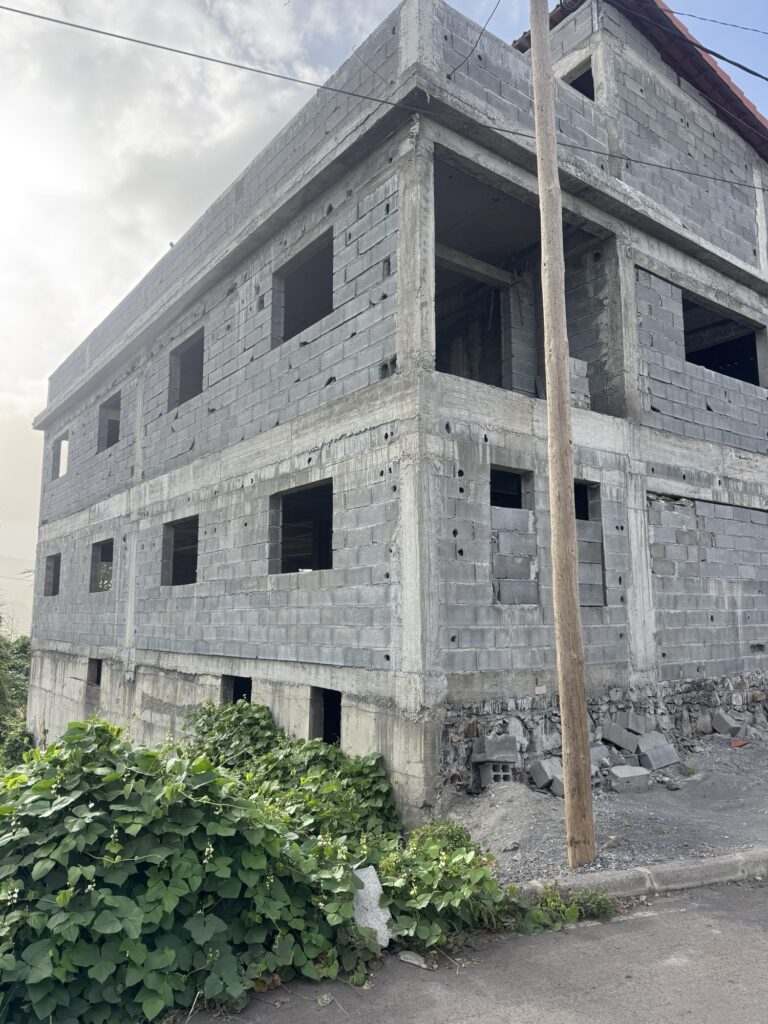
Yesterday, Maria O'Linda spontaneously invited us to her house. We are in Santiago in the mountain region, the Picos. Unfortunately, our communication was very poor due to our lack of language skills. We learn that she has a son who lives with her granddaughter in Portugal and that it has been two years since she has seen them. Maria has a few goats, pigs and chickens and loves plants. There are planters all around the house, they are ornamental plants and are cared for. We have these little encounters again and again on Cape Verde and everyone seems to love their home. However, we are surprised by the many ruined buildings, perhaps they are only ever built when there is money left over? But many houses in the shell are also inhabited. The grey concrete blocks are not attractive and rarely blend into the landscape, but there are still many plants on the terraces. When the houses are finished, they are painted in the brightest colours and adorn the landscape. However, paint is expensive and not affordable for everyone, and we also learn that you don't have to pay taxes on a shell of a house, which is perhaps the reason why many houses remain grey?

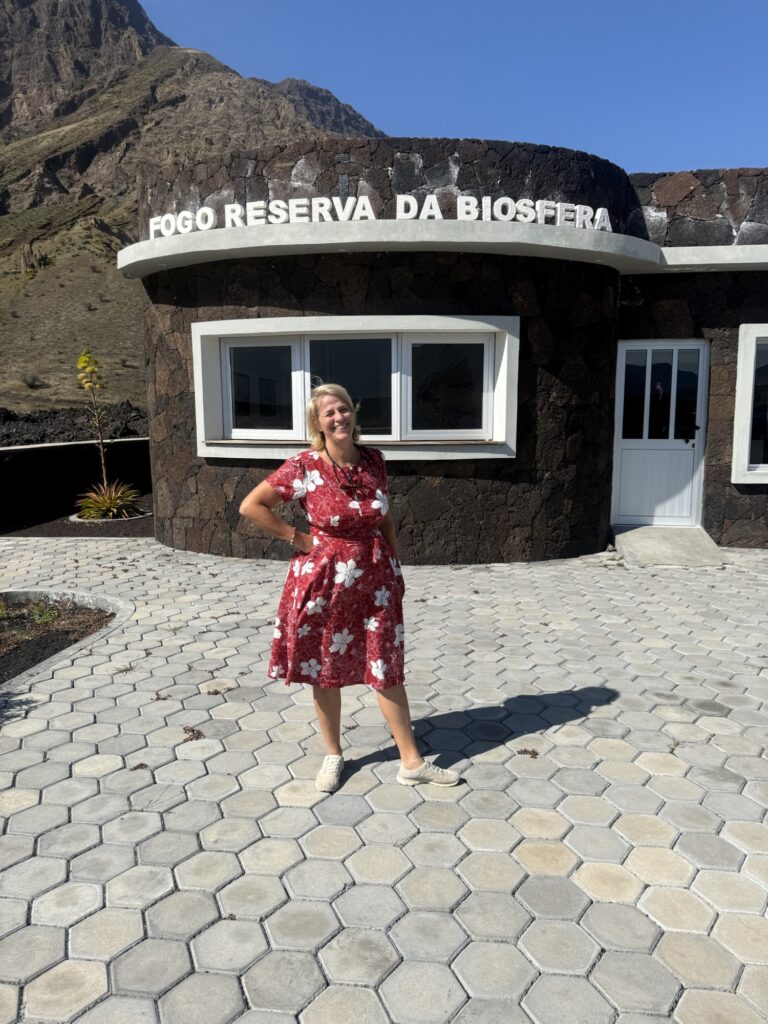
There are two UNESCO biosphere reserves in Cape Verde that are still very young. These are the biosphere reserves "Maio" and "Fogo", both of which tell the story of people's love for nature. Both were created by a local nature conservation organisation. In this blog, I will start with the Fogo biosphere reserve.
In Fogo, it all started with a turtle that a local fisherman brought to a biologist in his village. It was badly injured because it had become entangled in fishing nets. She was named Vitoria and was looked after and cared for. A swimming pool was built especially for her, but unfortunately, like so many turtles, Vitoria did not make it. After this experience, Herculando and his friends knew they wanted to do something and founded the nature conservation organisation Vito (short for Vitoria) in 2010. Since then, the organisation has not only taken care of turtles, but has also launched numerous other great projects for the protection of seabirds, endemic plants, sustainable fishing, environmental education, terrestrial reptiles and national and international volunteer work. The establishment of the Fogo Biosphere Reserve in 2020 was one of their most recent major successes. In order to be recognised as a biosphere reserve, the political representatives of Fogo's three municipalities must be convinced of the idea and give their approval. Numerous administrative and legal steps must then be taken and finally the UNESCO Commission must be convinced. After all, recognising a biosphere reserve is a national state act. Herculando says that it meant a lot to him to receive this honour and recognition from the state.
However, the official establishment of the biosphere reserve is still a long way from being a functioning biosphere reserve. A management plan was only drawn up at the last minute by external experts and does not necessarily meet the needs of nature and local people. In the meantime, a different party is in control of the political power than the one that pushed for the creation of the biosphere reserves - this makes it incredibly difficult. We learn that politicians care little about the biosphere reserve. This is very unfortunate, as Vito's 23 or so employees do such impressive and important work. Fortunately, the team members, who are almost exclusively from Fogo, find supporters, especially from philanthropic organisations abroad. If you are interested in the organisation, you can find a link here: https://projectovito.org/
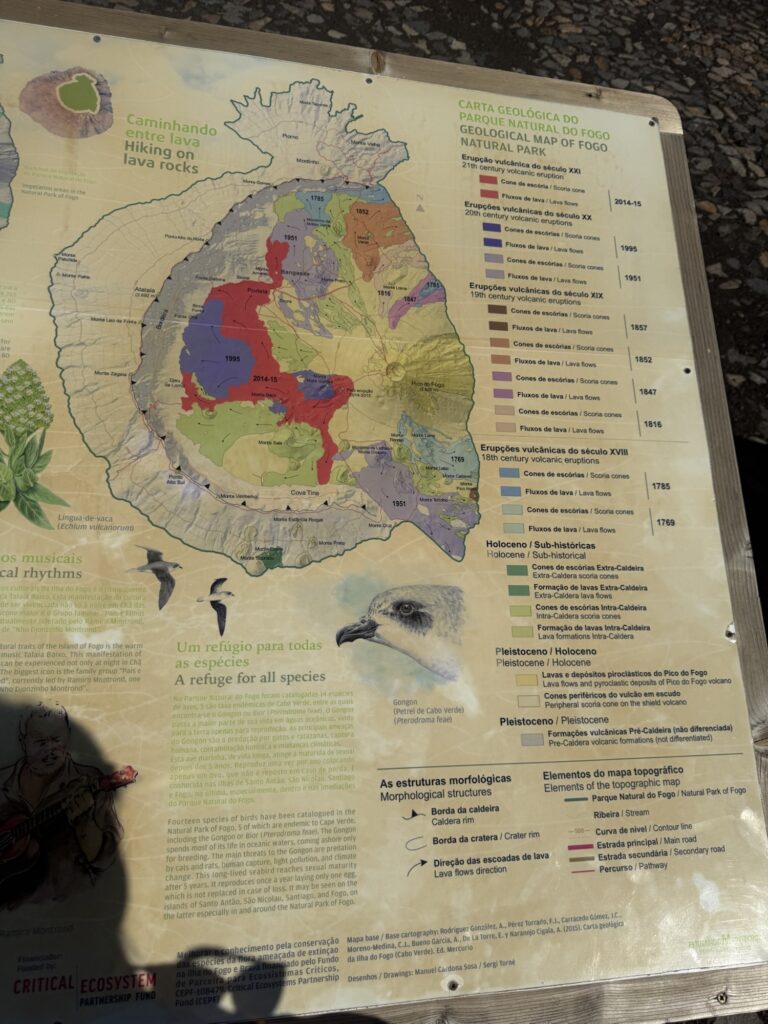
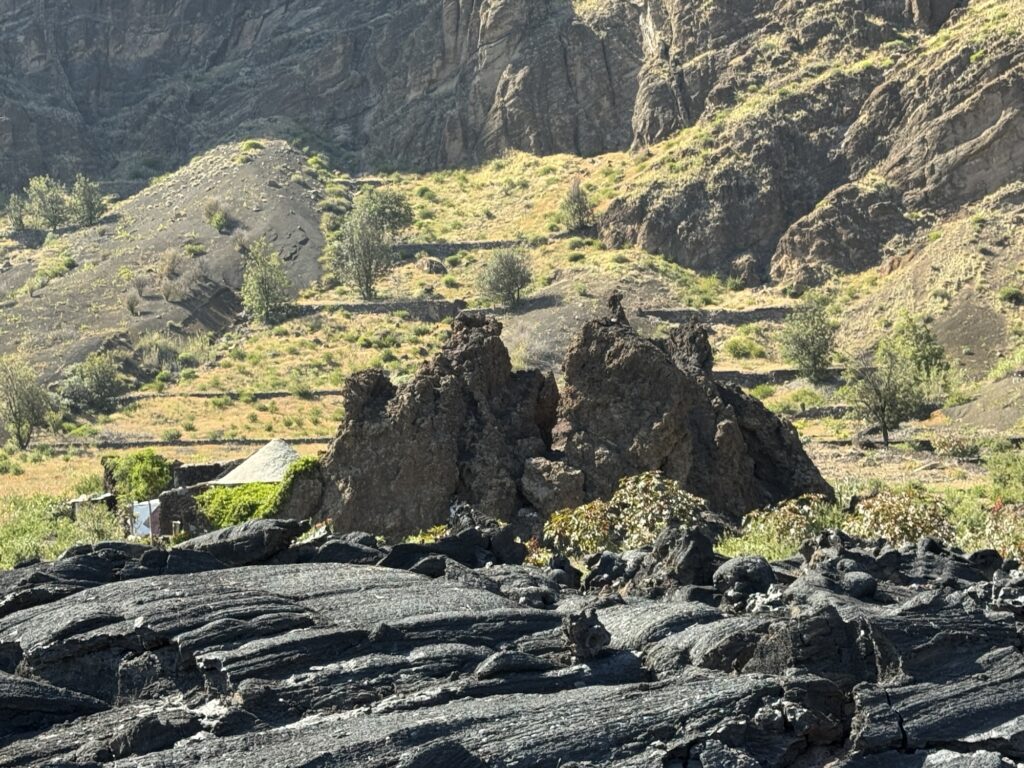
Fogo is the fiery one of the Cape Verde islands. A picture-book volcano towers 2890 metres high. It can be seen from the island of Santiago. Its last eruption was in 2014 and the traces are clearly recognisable. There are two villages in the crater that sank completely under the ash and lava. Residents watched as their houses disappeared with all their belongings inside. A common feature with the La Palma biosphere reserve, with which contact has already been established. In the volcanic crater on Fogo, an interesting information centre, which was created with the help of various donations, tells of Fogo's biodiversity.
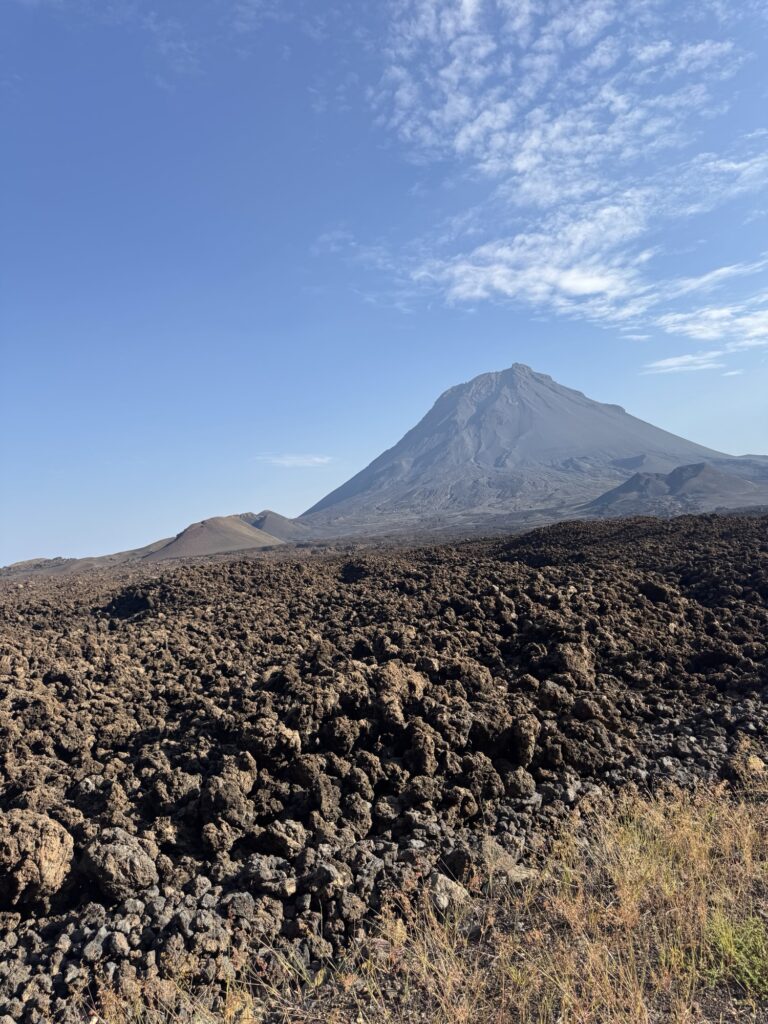
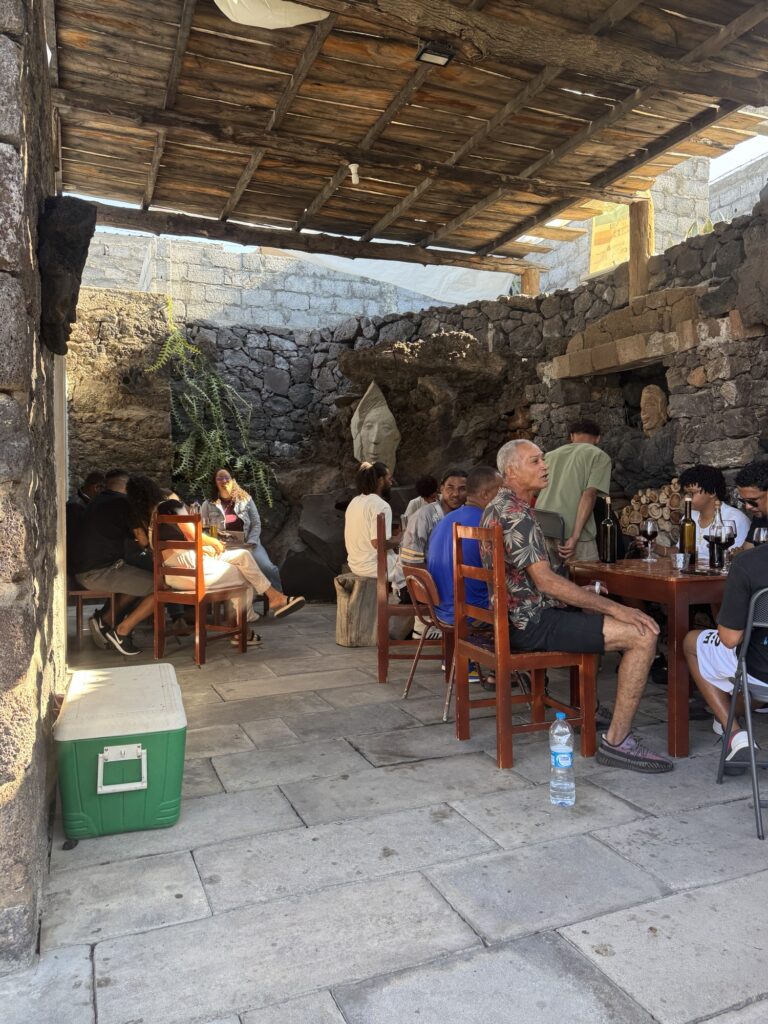
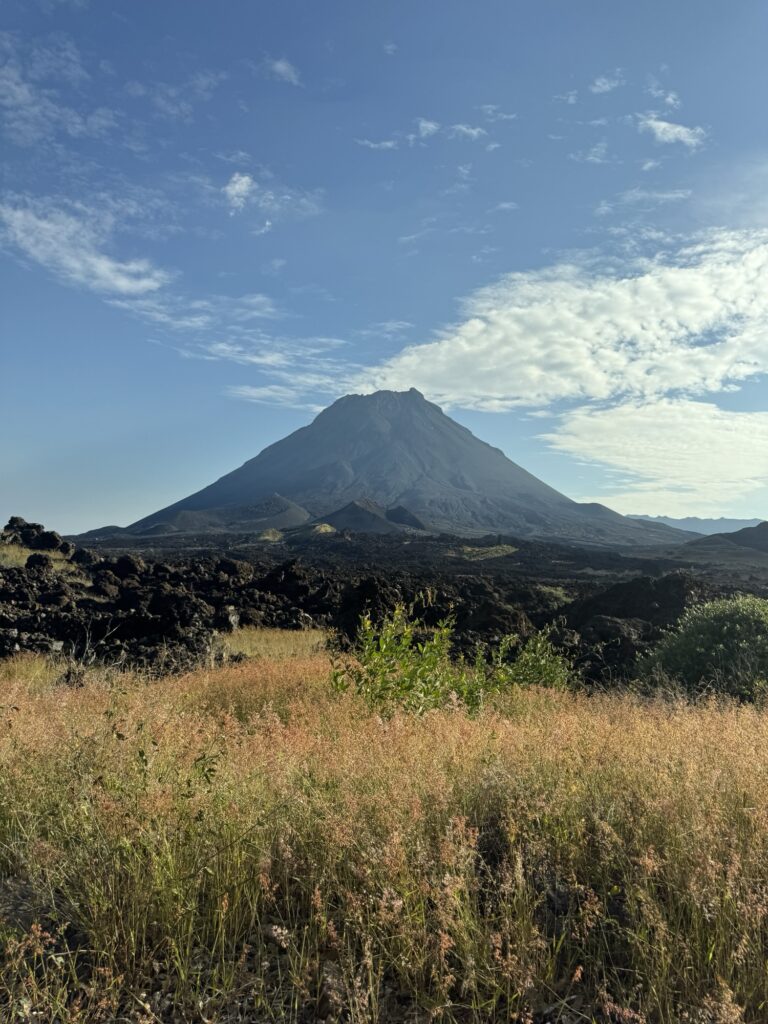
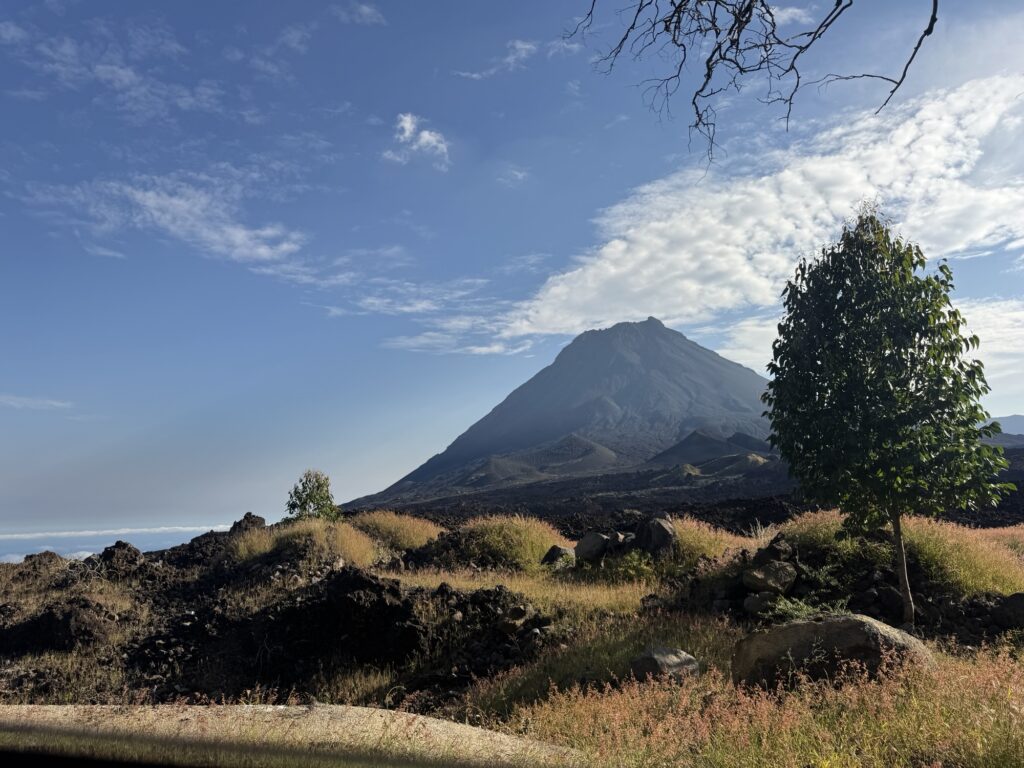
The villages are being rebuilt by the people. Seeing this triggers mixed feelings in me: what must it be like to live on a volcano and have to reckon with the fact that you have to watch again, that everything is taken? The wine, Fogo's speciality, is already growing on the ashes again. The wine from Fogo is very famous and we enjoy it in the pub on the edge of the crater. We are joined by a large group of home holidaymakers. There is a lot of fun and singing.
Herculando, director of Vito, has motivated us to support the idea of UNESCO biosphere reserves. Above all, it is the people who are involved and committed here who give us a lot of hope. Herculando has already had many jobs, but he finds Vito's foundation, the many different skills you need to lead a large team, such as acquiring money to keep the business running, repairing boat engines and looking after employees' injuries, very satisfying. We notice this too and listen to him enthusiastically on the second evening when we invite him onto our boat, which is anchored in Fogo's only harbour.
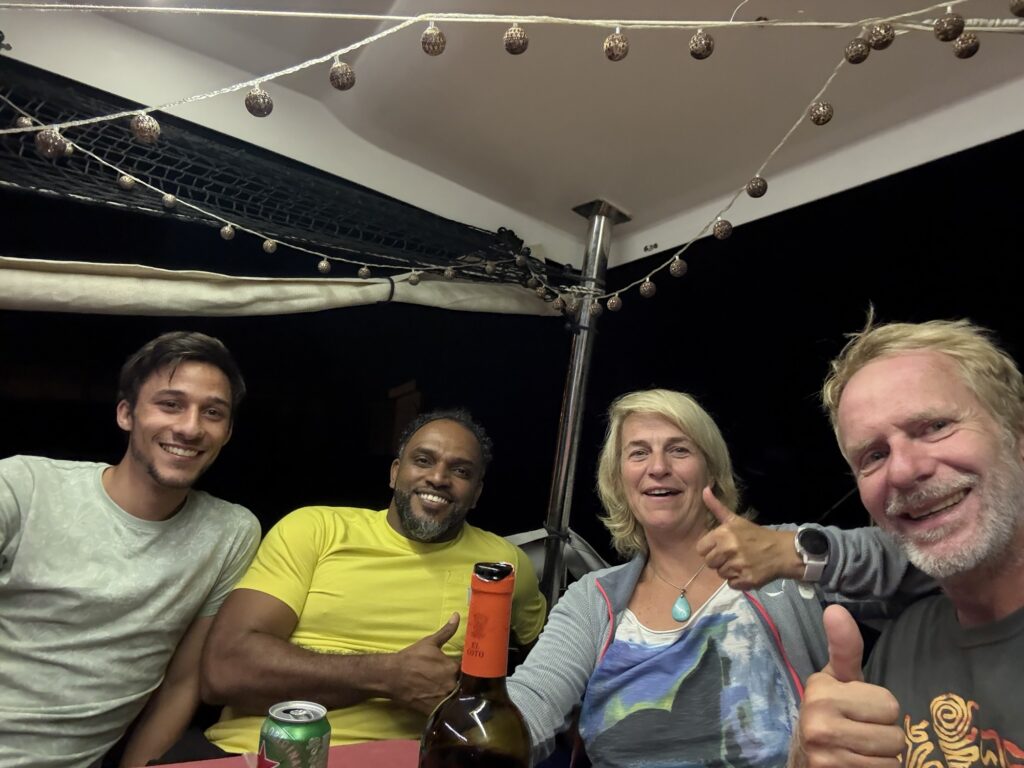
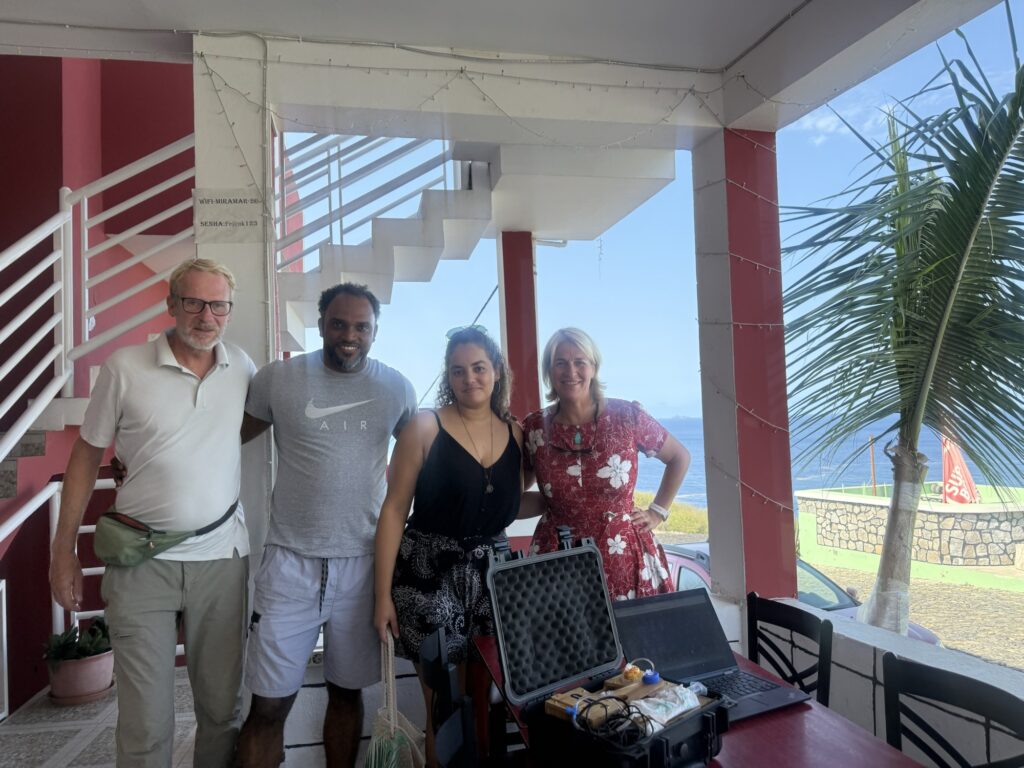
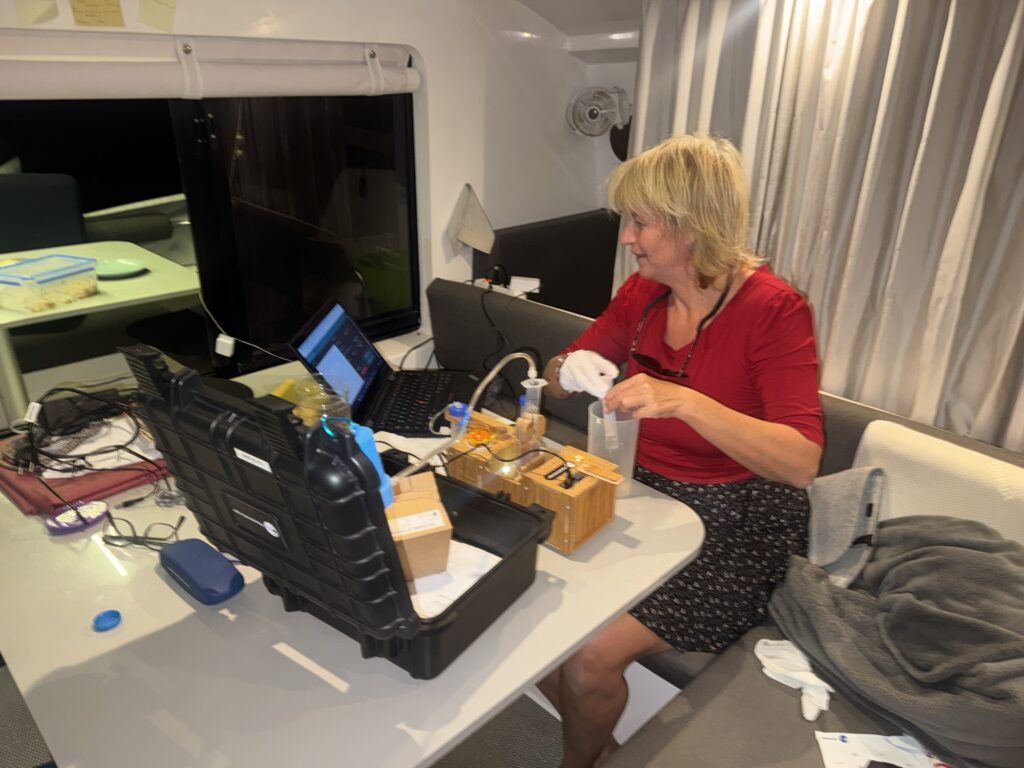
Ferries and cargo ships dock in the small harbour of Sant Filipe! We were startled to discover this on the first Saturday morning when a wild, loud roar woke us from our sleep. We anchored in the middle of the harbour bay because there was a big wave in the narrow harbour and the wild wind drove us onto the nearby beach and rocks. We knew that the ferry was coming in the morning and wanted to re-park beforehand, which we did in a hurry in the morning. There is actually only room for one sailing boat of our size in the harbour bay. The boat has to be secured with shore lines so that it doesn't run aground on the beach or get tangled up with fishing boats. But we didn't have to do it alone, as a local helped us for a fee. Secured with shore lines and strong winds from the shore, we now sit on board the biosphera with Herculando and Vanessa. Vanesse is a colleague of Vito, she is also from Fogo and is currently writing her doctoral thesis on the marine ecology of Fogo at the University of Edinburgh. There is hardly any basic information about the marine ecology around Fogo, her work aims to change this and she beams when she talks about the diverse marine life she discovers around Fogo. Vanessa and Herculando are also very interested in the planctoscope that I have had with me since Mindelo (Sao Vincente). With a planctoscope, you can visualise the smallest sea creatures (e.g. prehistoric crabs). The plankton can provide information about the quality of the marine ecology. With built-in Wi-Fi, a very good camera and AI-based software, this instrument should be suitable for collecting scientific data. Citizen science is an approach to research in which citizens actively collaborate with professional scientists to create new knowledge by collecting data, observing or analysing phenomena. In my case, I wanted to contribute by visualising plankton with the Planktoscope. I am very happy that Vanessa and Herculando will work much better with the" FairScope" (the name of the device) than I did. The FairScope was produced by a French organisation that makes it possible for smaller organisations to analyse plankton at a low "cost" (such a device costs around 6,000 euros). I very much hope that the biosphere reserve will benefit from the Planktoscope.
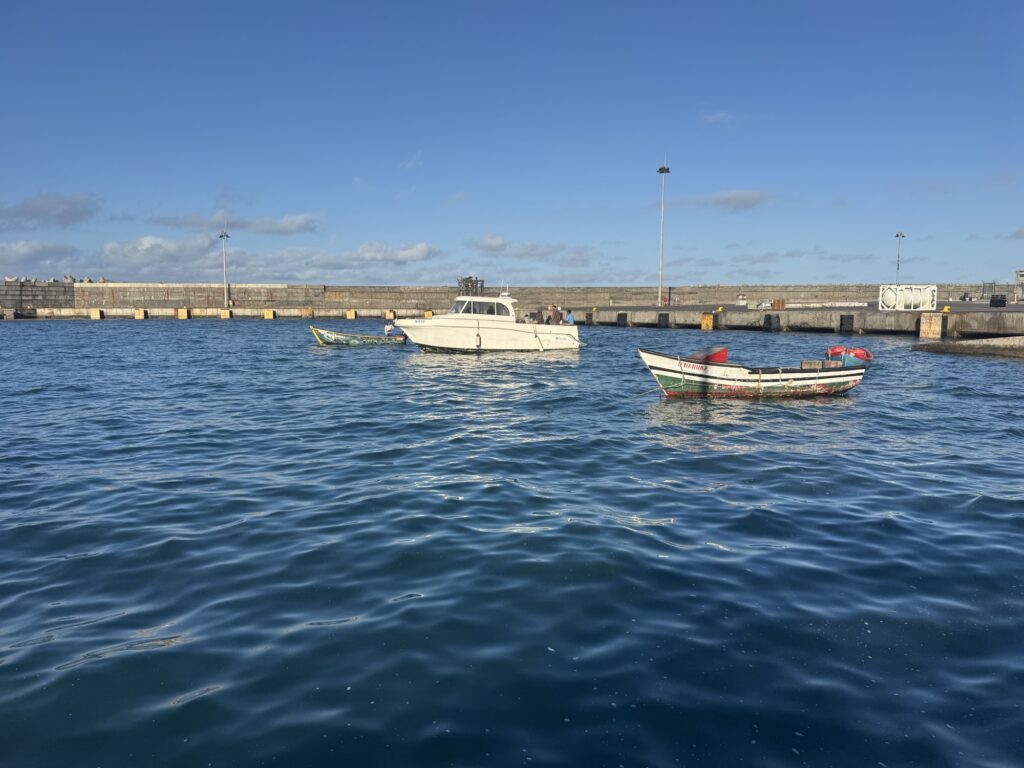
I would have liked to spend more time on Fogo and take part in the volunteer work. I recommend students who are interested in preserving biodiversity around the sea to come here and take part. The organisation's small boat takes employees to all sorts of different places and it's pure nature!
I didn't record data or press and collect plants in Fogo or on the other islands of Cape Verde like Humboldt or Darwin. However, I realised how much nature is formative and that the development of beauty also has to do with how the people who live here appreciate it. Andrea Wulf (p. 328) writes in her biography of Humboldt that he translated the word cosmos with the ancient Greek word "order" or "beauty" - "albeit an order and beauty created by the human eye." Humboldt thus connected the material outer world with the spiritual inner world. Humboldt's cosmos was about the relationship between man and nature." I also think that "seeing" is in turn influenced by ourselves. Do I only see the grey concrete buildings or also the many planters around the houses?
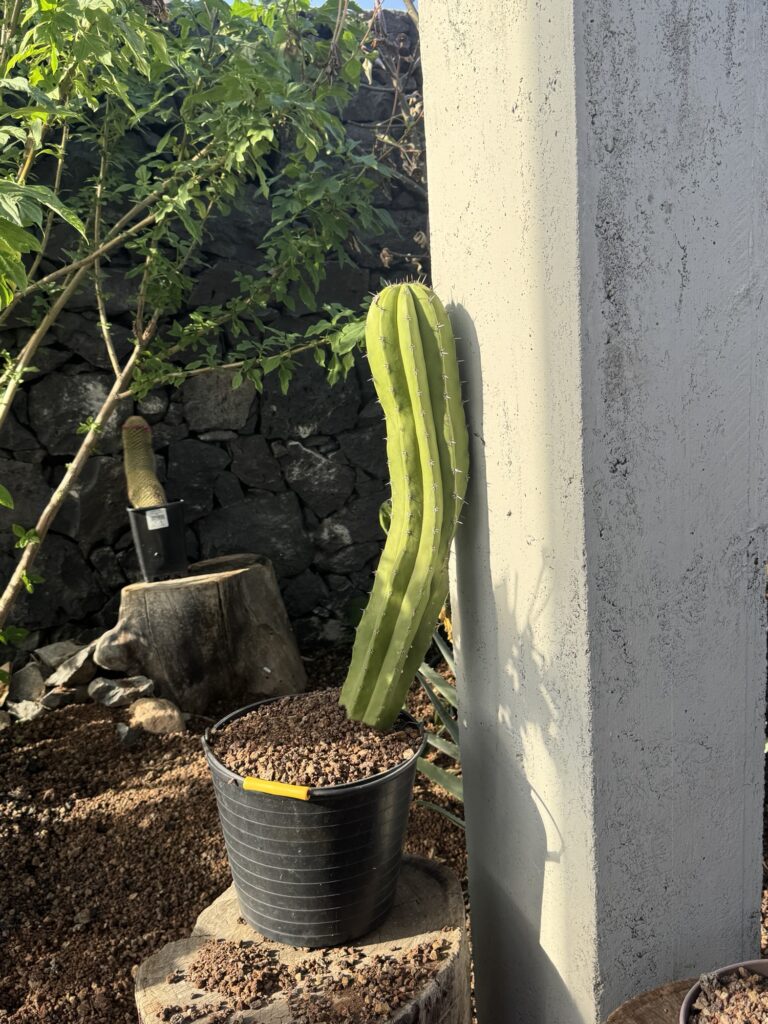
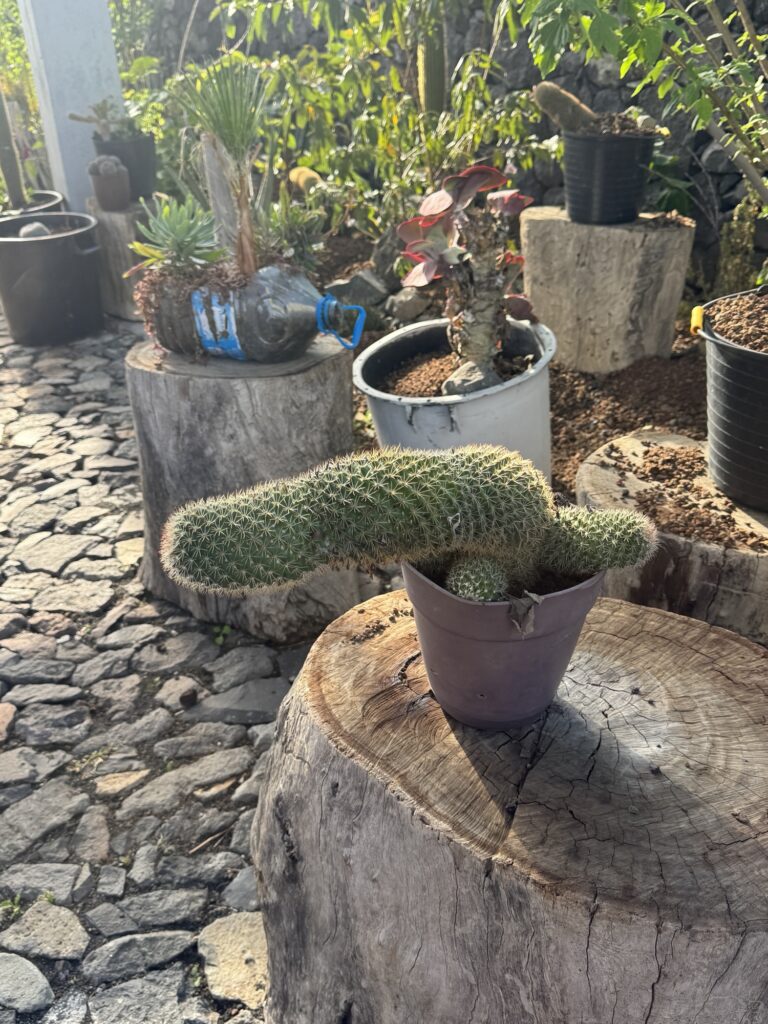
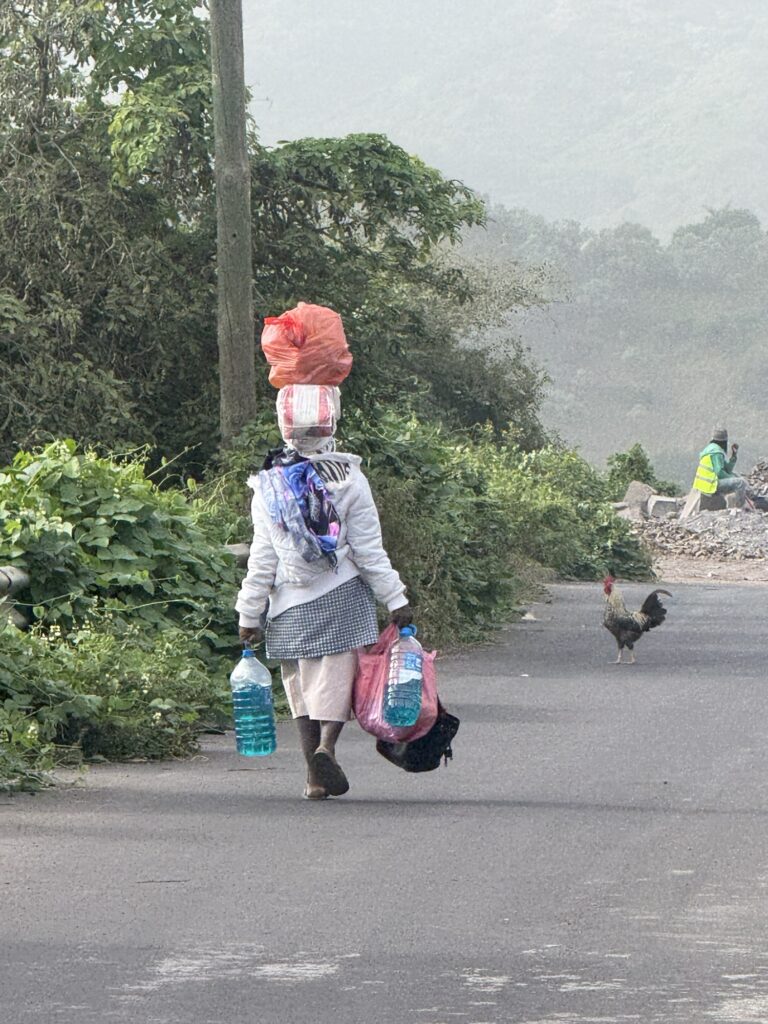
You lovely two, Katja and Martin!
What a beautiful report, Katja, impressive and interesting details and an atmosphere that one would only too gladly share!
Your postcard also arrived yesterday, Martin - in view of the relatively harsh winter here, I can hardly help but look at your pictures with envy. As always, the cold, dark season slowly becomes unbearable from the beginning of February; I still have a few performances in what is actually my last regular season at the Komische Oper, after which I almost soak up the applause at the end, but the grey, always dirty city really gets on my nerves.....
Yes, I would love to join you on the boat; - maybe with Stephan Wienhold; but I can't leave before 7 June, who knows where you will be then?
Keep me on the" swimming " in this regard, maybe we'll get it right after all....
Best wishes also from Susanne and good wind and ahoy,
Your Christoph